Many bloggers work hard but still struggle to make money. They write posts, get some traffic, and wait. Nothing much happens.
This usually isn’t a content problem. It’s a system problem.
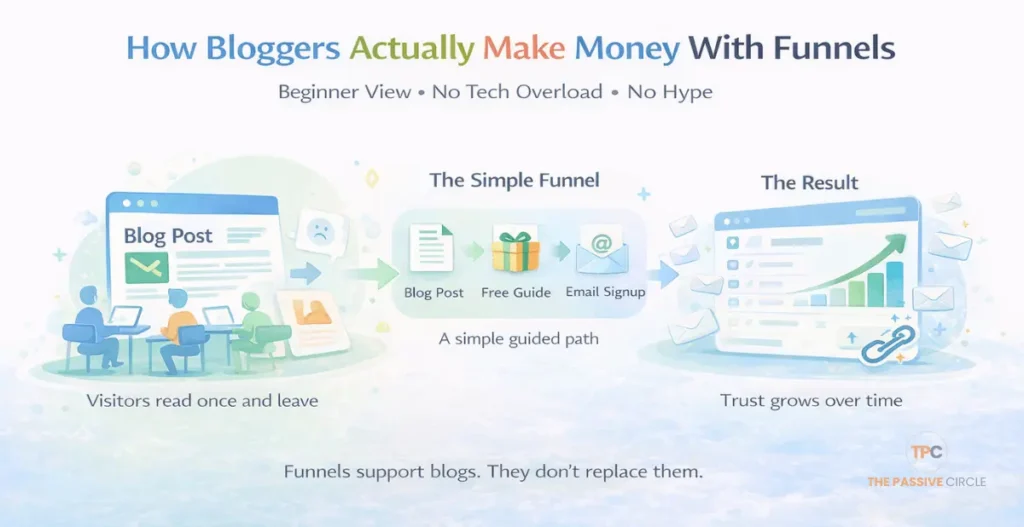
Most visitors read one post and leave. They don’t come back. There’s no clear next step. That’s where funnels come in.
In simple terms, a funnel helps guide readers instead of losing them. In affiliate marketing, this setup is often called an affiliate marketing funnel. But for bloggers, it’s much simpler than it sounds.
I used to think funnels were only for advanced marketers. I also believed I needed paid ads or a big audience first. That belief kept me stuck longer than it should have.
You don’t need to be an affiliate expert to understand this. This guide explains affiliate marketing funnels in simple blogger terms. No tech overload. No hype. Just how bloggers use simple funnels to support their blogs and earn over time.
Table of Contents
Why Many Bloggers Struggle to Make Money (Even With Traffic)
Many beginners believe that more traffic automatically leads to more income. It sounds logical, but it often doesn’t work that way.
A blog can get visitors every day and still make nothing. The reason is simple. Most readers come once, read one post, and leave.
There’s usually no clear next step for them to take. No reason to stay connected. No way to continue the conversation.
This is common in affiliate marketing for beginners. You focus on writing helpful content but don’t build a system to turn readers into subscribers.
Traffic alone is temporary. Once a visitor leaves, they’re gone. Without a way to bring them back, even good content struggles to earn.
This is the gap funnels are meant to fill. Not by pushing people, but by guiding them gently to the next step.
What a Funnel Really Is (In Blogger Terms)
A funnel isn’t a complicated system. It’s simply a guided path for your readers.
Instead of letting visitors read one post and disappear, a funnel helps you show them the next helpful step. That’s it.
For bloggers, this usually starts with content. Someone finds your blog through Google, reads a post, and finds something useful. Then you give them a simple option to stay connected.
In affiliate marketing, this process is commonly discussed in more formal terms, but bloggers usually experience it in a much simpler way.
A basic example looks like this.
A blog post leads to a free guide. The free guide leads to an email signup. Later, emails can include helpful suggestions or affiliate links.
Email plays a key role here because it allows you to continue the conversation after someone leaves your site. Without email, most readers are gone forever.
A funnel doesn’t replace your blog. Your blog still attracts readers. The funnel just helps you keep the right ones.
Funnel vs Blog Navigation (Simple Difference)

Many beginners think they must choose between blogging or funnels. That belief creates unnecessary pressure.
Blogs are great at attracting people. They help you get traffic from search engines and explain ideas in detail. This is often where trust begins.
Funnels do something different. They help guide interested readers after they finish reading. Instead of leaving, they’re given a simple next step.
For example, a blog post can explain a topic clearly. Inside that post, you might invite readers to join your email list to get a free beginner guide. That’s not replacing blogging. That’s supporting it.
Funnels work best when they sit quietly behind your blog. Your blog educates. Your funnel follows up.
This approach is especially useful for people learning affiliate marketing without a website, where email and simple pages often matter more than complex site structures.
Blogs bring people in. Funnels help you keep the right ones.
How Bloggers Actually Make Money With Funnels
Many beginners imagine funnels as aggressive sales machines. In reality, most bloggers use them in a very quiet way.
The most common path is simple. A reader finds a helpful post. They enjoy it. Then they’re offered something small and useful in return for their email.
This is where email marketing for beginners becomes important. Email allows you to follow up slowly, without pressure. You’re not trying to sell on day one. You’re building familiarity.
Over time, some emails may include recommendations. These could be tools, services, or resources the reader already needs. This is how an affiliate marketing funnel works for bloggers in practice.
Income usually comes in small steps. One subscriber. One click. One commission. It grows as trust grows.
Pageviews alone don’t create this. Relationships do. Blogging funnels simply make those relationships possible without relying on social media or constant traffic.
A Simple Blogging Funnel Example (No Tech Overwhelm)
Let’s keep this very simple. No tools. No setup talk yet. Just the idea.
A reader finds one of your blog posts through Google. The post helps them solve a small problem. That’s step one.
At the end of the post, you offer a free resource. It could be a checklist, a short guide, or a starter toolkit. This is how you collect emails without a website using just one simple page.
Once they join, you send a welcome email. Not a pitch. Just something helpful. This is the start of an email funnel for bloggers, even if it doesn’t feel like one.
Later, when it makes sense, you may recommend one tool or resource you already use. That’s the affiliate part. No pressure. Just relevance.
That’s it. No ads. No complex pages. Just a blog supporting a simple funnel in the background.
Step-by-Step Flow (Beginner View)
Step 1: Helpful blog content
Step 2: One free resource
Step 3: Simple email follow-up
Step 4: Relevant affiliate recommendation
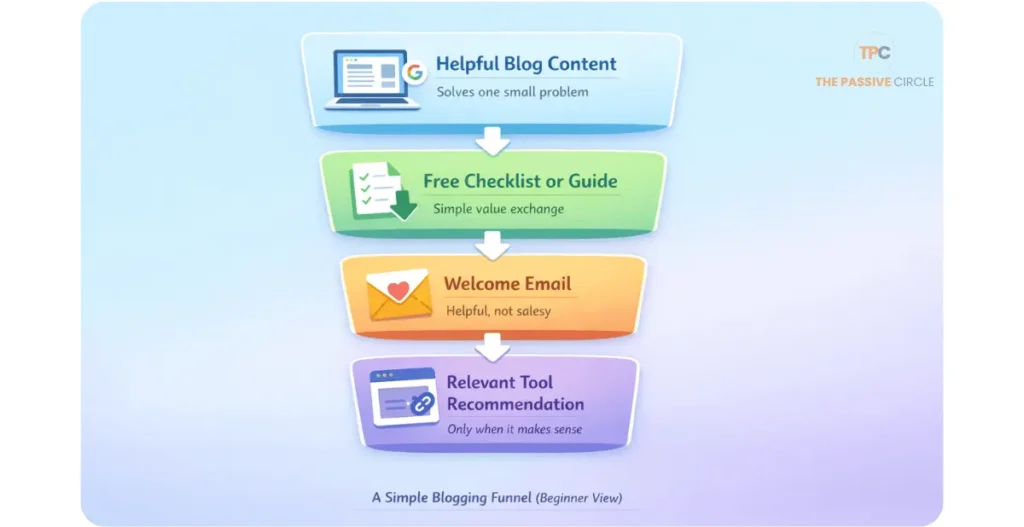
This is often called a blogging funnel for beginners, but it’s really just a clear path for your readers.
Common Myths Beginners Have About Funnels
Funnels often sound more complicated than they really are. This leads to a lot of unnecessary fear.
One common belief is that funnels are only for experts. In reality, most bloggers start with very basic setups. One post. One free resource. One email follow-up.
Another fear is thinking you need paid ads. You don’t. Many bloggers build funnels using only blog traffic and simple email tools. Ads are optional, not required.
Some beginners also believe they need a big audience first. That’s backwards. Funnels are what help you make the most of a small audience, not the other way around.
There’s also the idea that funnels are scammy. This usually comes from seeing aggressive sales pages. A beginner-friendly affiliate marketing funnel doesn’t push people. It helps them move at their own pace.
Funnels don’t force decisions. They reduce confusion.
What Funnels Are NOT (Important for Beginners)
Funnels are often misunderstood because of how they’re marketed online. It’s important to clear this up early.
First, funnels are not overnight income systems. If someone promises instant results, that’s a red flag. Real funnels grow slowly, just like blogs do.
Funnels are also not about pushing people to buy. A beginner-friendly setup focuses on helping first. Selling, if it happens, comes much later.
Another misconception is that funnels replace learning the basics. They don’t. You still need to understand content, audience, and trust. Funnels simply organize what you’re already doing.
This matters even more if you’re exploring affiliate marketing for beginners, where credibility is everything. Without trust, funnels don’t work at all.
Think of funnels as structure, not shortcuts.
Common Beginner Funnel Mistakes (And How to Avoid Them)
One common mistake is trying to build everything at once. Beginners often want a blog, funnel, emails, and tools all set up perfectly. This usually leads to burnout.
Another mistake is promoting too many tools. When everything is recommended, nothing feels trustworthy. A simple affiliate marketing funnel works best when it focuses on one clear problem and one helpful solution.
Skipping email relationship building is another issue. Some beginners collect emails but never send helpful content. Without communication, the funnel quietly stops working.
Many people also copy advanced funnels too early. What works for big marketers often doesn’t work for beginners. Simple systems are easier to manage and easier to trust.
Funnels don’t fail because they’re broken. They fail because they’re built before the basics are understood.
Do Bloggers Need Special Tools to Start Funnels?
Many beginners think funnels require expensive or complex tools. That’s usually not true at the beginning.
Early on, simple tool like Systeme.io is better. Fewer features mean less confusion. The goal is to understand the process, not to build something perfect.
For bloggers, an all-in-one setup can be helpful because it reduces moving parts. Instead of connecting several tools, everything lives in one place. This makes learning easier and mistakes easier to fix.
This is why some beginners later explore beginner-friendly funnel tools that combine email, landing pages, and basic automation. Tools like these are optional, but they can save time once you understand the basics.
If you’re still learning how email fits into funnels, it’s worth understanding the fundamentals first before worrying about software.
When Funnels Make Sense (And When They Don’t)
Funnels make sense when you already have helpful content. If your blog answers real questions and attracts the right readers, a funnel can quietly support that work.
They’re also useful when you want to build long-term connections. Email allows you to stay in touch without depending on social media algorithms or constant new traffic.
Funnels don’t make sense when the basics aren’t ready. If you’re still unsure about your topic, audience, or content direction, it’s better to focus on blogging first.
Some beginners feel pressure to build funnels early. There’s no rush. Blogging alone is enough in the beginning, especially while you’re learning.
Funnels are tools, not requirements. They’re there to help when you’re ready, not to replace the work you’re already doing.
The Mindset Shift Bloggers Need to Understand Funnels
Funnels work best when you stop thinking of them as marketing tricks. They’re simply a way to bring clarity to your blogging.
Instead of asking, “How do I sell something?” it helps to ask, “What would help this reader next?” That small shift changes everything.
A simple email funnel for bloggers isn’t about pressure or persuasion. It’s about continuing a helpful conversation after someone leaves your site.
You don’t need to build everything today. One post. One free resource. One email. That’s enough to start learning.
Funnels grow with you. As your confidence improves, your systems can improve too. Until then, keeping things simple is often the smartest move.
If you understand this mindset, funnels stop feeling intimidating. They become a quiet support system behind your blog, not the main focus.
FAQs About Affiliate Marketing Funnels for Bloggers
1. What is an affiliate marketing funnel in simple terms?
An affiliate marketing funnel is a simple path that guides readers from a blog post to a helpful recommendation. Instead of sending visitors directly to affiliate links, you first help them, collect emails, and build trust.
For bloggers, this usually means blog post → free resource → email follow-up → affiliate offer.
2. Do bloggers really need a funnel to make money?
You don’t need a funnel to start blogging, but funnels make earning more predictable. Without a funnel, most visitors leave and never come back.
A simple blogging funnel helps bloggers turn traffic into long-term income instead of one-time clicks.
3. What is a blogging funnel for beginners?
A blogging funnel for beginners is a basic setup that does not require advanced tools or paid ads. It usually includes one helpful blog post, a free checklist or guide, and a short email sequence.
This approach is beginner-friendly because it focuses on help first, sell later.
4. How do bloggers actually make money with funnels?
Bloggers make money when readers trust their recommendations. Funnels allow bloggers to educate readers over time through email instead of pushing links immediately.
Most successful bloggers earn through affiliate commissions, digital products, or services after building trust inside the funnel.
5. Can you create an affiliate marketing funnel for free?
Yes, beginners can create an affiliate marketing funnel for free. You can use free blogging platforms, free email tools, and simple lead magnets like checklists or PDFs.
Paid tools help later, but they are not required to start learning how funnels work.
6. What is an email funnel for bloggers?
An email funnel is a sequence of emails sent after someone joins your list. These emails educate, solve problems, and gradually introduce affiliate recommendations.
For bloggers, email funnels are powerful because they allow repeated contact without depending on search traffic alone.
7. How do I start an email funnel as a beginner?
Start with one goal. Create a simple free resource related to your blog post and connect it to a short email sequence of 3–5 emails.
You don’t need automation or complex logic at the beginning. Consistency and clarity matter more than tools.
8. How much is a 1,000-email subscriber list worth?
A 1,000-email list does not have a fixed value. It depends on trust, relevance, and how well the funnel is built.
For beginners, a small engaged list can earn more than a large inactive list if the funnel is helpful and focused.
9. Can bloggers really make $1,000 a month with affiliate funnels?
Yes, but not immediately. Bloggers who make $1,000 a month usually have traffic, a working funnel, and consistent content.
For beginners, the goal should be learning and building systems first, not chasing income numbers.
10. How much can a beginner realistically earn from blogging?
In the beginning, earnings are often small or zero. This is normal. Blogging income grows as traffic, trust, and funnel structure improve.
Most successful bloggers treat blogging as a long-term project, not a quick win.
11. Do affiliates get paid for ads or clicks?
Yes, paid ads can be used, but they are not beginner-friendly. Ads require testing, budget, and experience.
For beginners, organic traffic from blogging is safer and less stressful while learning funnels.
12. Are blogs top-of-the-funnel content?
Yes. Blog posts are usually top-of-the-funnel, meaning they attract people who are just starting to research.
Funnels help move those readers deeper, from learning to trusting to buying.
13. What is the key to success with blogging funnels?
The key is patience and simplicity. One clear problem, one helpful blog post, and one simple blogging funnel work better than complex systems.
Most beginners fail because they overcomplicate instead of building step by step.
14. What is the 80/20 rule in blogging and funnels?
The 80/20 rule means that a small number of blog posts and funnels usually generate most of the income. Not every post needs to convert.
Focus on creating a few strong funnel-based posts instead of publishing endlessly.
15. Are funnels necessary for blogging success?
Funnels are not mandatory, but they make success more predictable. Without funnels, income depends heavily on traffic spikes.
With funnels, bloggers can earn consistently even with modest traffic.
If you want a deeper understanding of how an all-in-one funnel tool like Systeme.io works, I’ve covered everything step by step in this detailed guide:
Systeme.io Ultimate Guide: Login, Pricing, Features, Reviews, and How to Get Started