This post may contain affiliate links. If you purchase through these links, I may earn a small commission at no extra cost to you. Read our full Affiliate Disclosure

Does Keyword Density Matter Anymore? Yes, keyword density still plays a role in SEO. While it’s no longer the main ranking factor, using your keyword naturally and strategically remains important for helping search engines understand the topic of your content. Let’s deep dive into this.
Keyword density shows how often your primary keyword appears in your content. It is the balance between using the keyword enough times for Google to understand the topic and using it in a way that still feels natural to the reader. You do not need to be perfect with numbers. You only need to keep your writing smooth and clear.
Think of keyword density like adding salt to food. If you add no salt, the food tastes plain. If you add a little salt, it tastes good. If you add too much, the food becomes hard to enjoy. Keywords work the same way. A little is helpful. Too much feels forced and uncomfortable.
Table of Contents
What is Keyword Density
Here is an easy way to see how keyword density works in real writing.
In one hundred words, using your keyword one time is around one per cent. Using it twice is around two per cent. Using it seven times is too much and feels heavy.
In 1,000 words, 10 uses is around 1 per cent. Fifteen uses is around 1.5 per cent. Twenty uses is around two per cent. These are safe and natural ranges.
Keyword density formula looks like this:
Keyword Density = (Keyword Count ÷ Total Word Count) × 100
For example, if you write a 1,000-word article and your target keyword shows up 10 times:
(10 ÷ 1000) × 100 = 1%
That means your keyword density is 1 percent.
You do not need to hit an exact number. You only need to aim for natural use. Your main goal is to deliver explicit, human content.
What Good and Bad Keyword Density Looks Like
A good example feels like this.
Many people search for affiliate marketing for beginners because they want a simple way to start earning online. In this guide, you will see how to get started with a small budget.
The keyword appears, but the writing still flows.
A bad example feels like this.
This guide is for beginners in affiliate marketing. If you want to learn affiliate marketing for beginners, this guide will help you do so.
This feels fake and heavy. It is not helpful for the reader.
How Much Keyword Density You Should Aim For
A safe range is one to two per cent. This works for most blog posts. Do not try to hit a perfect number. Natural writing is always more important. If your keyword appears too often, the content feels repetitive. If it seems too little, Google may not understand your topic.
Here is a simple rule.
If the keyword feels heavy, remove some uses.
If the keyword is missing for long sections, add it once in a natural place.
Tips to Keep Keyword Density Natural
Start by writing your content first. Do not think about keyword density during the first draft. Your goal is to teach and help the reader. After that, add your keyword in strong spots like the title, H1, URL, first paragraph, one subheading, one image alt text, and the meta description.
Read your content out loud. If you feel bored repeating the keyword, cut it down. Replace some uses with related terms, such as ‘beginner affiliate guide’ or ‘start affiliate marketing from scratch’. These variations keep your content natural and human.
Avoid chasing exact numbers. You do not need to reach 1.5 per cent. You only need balance.
Tips for Affiliate Sites
Affiliate content can easily fall into keyword stuffing when writers repeat product names too often. You can avoid this by mixing your words.
Bad example in reviews
In this Hostinger review, we take a look at Hostinger. This Hostinger review is the best Hostinger review for people who want a Hostinger review.
Better example
In this Hostinger review for beginners, I share my real experience using Hostinger for my first affiliate blog. You will see what I liked and where I faced issues.
Use a mix of phrases like
- Hostinger review for beginners
- Cheap hosting for new bloggers
- My experience using Hostinger on The Passive Circle
This mix keeps your keyword density safe and your writing helpful.
How Keyword Density Connects to Trust
Keyword density is not a direct part of E E A T, but bad density can reduce trust. When content feels spammy, people leave fast. They do not trust the advice, and they do not share your post. Natural writing has the opposite effect. People stay longer, explore more pages, and may even buy through your links.
An example that builds trust
In my own journey with affiliate marketing for beginners, I made many mistakes on my first site. Here I share what worked for me while working my full-time job in Dhaka.
The keyword appears one time, but the sentence feels genuine and honest.
Why Keyword Density Matters
Keyword density helps Google understand your topic. It also stops you from repeating the same line too many times. Natural writing keeps readers happy. When readers stay longer, Google sees this as a positive signal.
Too much density can make your content hard to read and can trigger spam filters. Balanced density supports your topic, helps your ranking, and keeps your tone friendly.
A Simple Process for Every Post
Choose one main keyword. Add it in strong SEO spots like the title, H1, URL, first paragraph, one H2 or H3, one image alt text, and the meta description. Write your post entirely. After finishing, reread it. If the keyword feels heavy, remove or replace some uses.
If you want, you can use a free keyword density checker tool like Rank Math, but trusting your ear is enough.
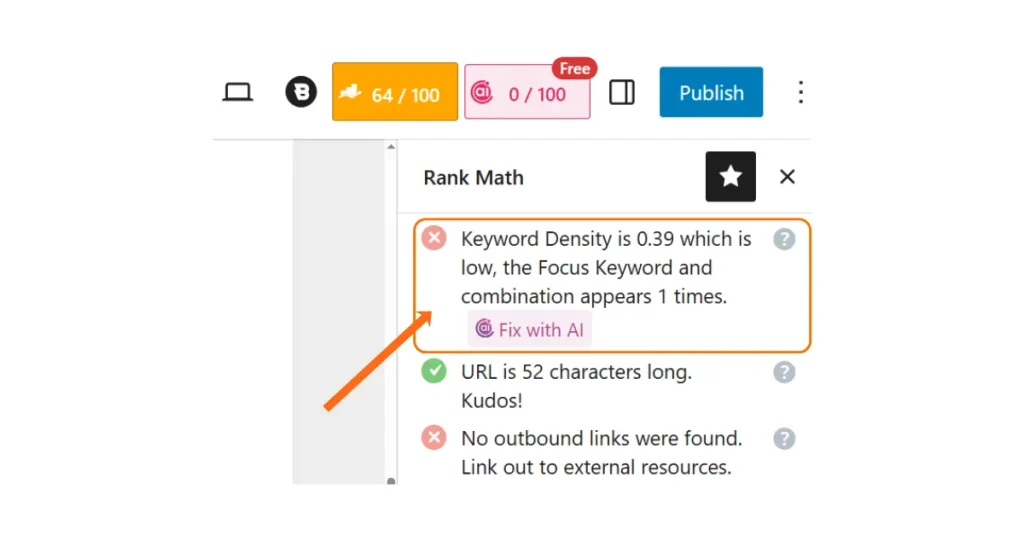
Quick Questions Before You Publish
Ask yourself these questions.
- Did I choose one primary keyword
- Is it in the title, H1, and URL
- Is it in the first paragraph
- Did I use related terms
- Does the writing feel natural when read aloud
If the answer is yes, your keyword density is safe and strong.
If you don’t know which keywords beginners should target,
this guide will show you how to find low-competition keywords for free.
FAQs about Keyword Density in SEO
1. Does keyword density matter anymore?
Yes, keyword density still plays a role in SEO. While it’s no longer the main ranking factor, using your keyword naturally and strategically remains important for helping search engines understand the topic of your content.
However, keyword stuffing can hurt your rankings, so it’s important to strike a natural balance. It’s not as critical as it once was. Search engines now prioritize content quality, context, and relevance over strict keyword repetition. Focus on writing for the user first, with the keyword naturally included.
2. What is an SEO keyword density tool?
An SEO keyword density tool helps you check how often your target keyword appears in relation to the total word count of your content. It can help you maintain the ideal keyword density and avoid overstuffing.
3. What is the best keyword density for SEO?
The best keyword density for SEO is typically between 1% and 2%. This range ensures your content is optimized without overusing the keyword, maintaining readability for both users and search engines.
4. What is the keyword density formula?
The keyword density formula is:
(Keyword Occurrences ÷ Total Words) × 100.
For example, if you use your keyword 5 times in a 500-word article, your keyword density is (5 ÷ 500) × 100 = 1%.
5. What is a keyword density checker tool?
A keyword density checker tool analyzes your content and calculates how many times your target keyword appears. It provides a quick way to assess if you are using the right amount of keywords in your content.
6. How much keyword density is good for SEO?
A good rule of thumb is to keep your keyword density between 1% and 2%. This ensures your content is optimized without overusing the keyword, making your writing more natural and less robotic.
7. How to check keyword density?
To check keyword density, you can use SEO tools like Google’s Keyword Planner or specific keyword density checker tools. These tools allow you to easily see how often your keyword appears in relation to the total word count of your content.
Keywords and Intent SEO Navigation
Keyword Placement | Keyword Density | Keyword Optimization | Search Intent Matching | Semantic Keywords | LSI Keywords
Read my ultimate beginners friendly SEO guides. Learn & apply.