This post may contain affiliate links. If you purchase through these links, I may earn a small commission at no extra cost to you. Read our full Affiliate Disclosure

When I started blogging after office hours, I thought helpful content was enough. I wrote a few posts based on what I was learning in affiliate marketing. But even after weeks, my traffic was still almost zero.
At first, I thought my writing was the problem. Maybe I needed better design or more plugins. But later I realized something important.
I was writing blog posts that nobody was searching for.
Like most beginners, I picked topics based on:
- What I liked
- What others were writing
- What sounded useful
But I never checked if people were actually typing those topics into Google.
That’s why my blog wasn’t getting traffic.
I didn’t know how to do keyword research for free. In fact, I knew nothing about keyword research at that time. I thought SEO tools were expensive and out of my reach.
Everything started to change when I learned how to find low competition keywords using free methods. Instead of guessing blog topics, I started writing content people were already searching for.
Slowly, I got my first organic visitors without spending any money.
If you want to see the exact beginner steps I followed, check:
👉 How I Finally Got My First 100 Visitors with Zero Budget (Proven Beginner Steps)
In this guide, I’ll show you how to do keyword research for free and find easy-to-rank keywords for your blog. I’m sharing the same step-by-step process I’m learning and applying in my own affiliate journey.
You don’t need technical SEO knowledge to get started. You just need the right approach.
Table of Contents
What is Keyword Research in Blogging?
Keyword research means finding out what people type into Google when they are looking for help. It helps you choose blog topics that already have demand. Instead of guessing what to write, you create content based on real search queries.
For example, someone may search:
- how to start affiliate marketing
- best email tools for beginners
- low competition niche ideas
These are called keywords.
When you write a blog post around these terms, Google understands what your content is about. This increases your chance of appearing in search results when someone looks for that topic.
Before I learned this, I used to write posts based on what I thought was useful. But usefulness alone does not bring traffic. Your content must match what people are actively searching for.
This is also important when choosing your niche. If nobody searches for your topic, even the best content may not get visitors.
You can see how I validated search demand before choosing my niche in this guide:
👉 How to Find a Profitable Niche for Affiliate Marketing Beginners (Low Competition Guide)
In simple words, keyword research connects your content with real people who need it.
Why Keyword Research Matters for New Bloggers
Many beginners believe they need backlinks before they can get traffic. So they focus on writing more posts and wait for results. I followed the same approach in the beginning, but nothing changed.
The real issue was not the number of blog posts. It was that I was writing random content without checking search demand. Even helpful posts can stay invisible if nobody is searching for that topic.
Keyword research helps you avoid this mistake.
Instead of writing based on:
- Assumptions
- Trends
- Personal interest
You write based on:
- Search demand
- User intent
- Ranking opportunity
This is why some new blogs get traffic even without backlinks. They focus on low competition keywords that match beginner-level authority.
For a new affiliate blog like mine, this creates a real opportunity. You don’t need to compete with big websites on highly competitive terms. You can start ranking by targeting specific problems beginners are searching for.
If you’re still getting started with affiliate blogging, this guide may help:
👉 Affiliate Marketing Guide for Beginners: 7 Simple & Proven Steps
And to avoid common early mistakes, also check:
👉 Avoid These 10 Affiliate Marketing Mistakes Beginners Always Make
Keyword research gives your blog direction. It helps you create content that has a chance to rank from day one.
Types of Keywords You Should Target First
As a new blogger, not all keywords are worth targeting in the beginning. Some keywords are too competitive for a new website to rank. Others are easier to rank for if you choose them carefully.
Here are the main types of keywords you should understand:
| Keyword Type | Example | Purpose |
|---|---|---|
| Informational | how to start affiliate blog | Learn something |
| Commercial | best SEO tools for beginners | Compare options |
| Buyer Intent | buy email marketing software | Make a purchase |
| Long Tail | low competition niche for beginners | Easier to rank |
For beginners, long tail keywords are usually the best starting point. These are more specific search queries with lower competition. They may bring less traffic individually, but they are easier to rank for.
Also, different keywords have different intent. Some users want to learn, while others want to compare tools before buying. Understanding this helps you create the right type of content.
To learn more about keyword intent, check:
👉 Search Intent SEO: 5 Simple and Effective Ways to Understand User Intent
When your content matches user intent, Google is more likely to show your blog in search results.
What is Keyword Difficulty? Can New Blogs Compete?
Keyword difficulty shows how hard it is to rank for a specific search term. Some keywords are already dominated by big websites with high authority. Competing with them as a beginner can be very difficult.
When I started my blog, I used to target broad keywords like “affiliate marketing tips”. But most of the top results were from websites with years of experience and strong backlinks. That made it almost impossible for my new blog to appear on the first page.
That’s why it’s important to check the authority of the websites ranking for your target keyword.
You can start by learning how to measure this using:
👉 Check Domain Authority: Simple Guide for Beginners (Free Tools Included)
This helps you understand how strong your competitors are.
You should also know the difference between Domain Authority and Domain Rating before analyzing keyword competition. You can read:
👉 Domain Rating vs Domain Authority: Simple Comparison for Beginners
As a beginner, your goal should be:
- Target keywords with low competition
- Avoid high authority competitors
- Focus on specific search queries
This increases your chance of ranking even without backlinks.
How to Find Easy Keywords for Your Blog (Step-by-Step)
When your blog is new, you don’t need high search volume keywords. You need easy-to-rank keywords that match your current authority level.
In the beginning, I used to pick topics that sounded helpful. But after learning keyword research, I started checking whether smaller blogs were already ranking for that topic.
Here’s a simple way you can do it.
Step 1: Start with a Broad Topic
Think about a problem your reader may have.
Examples:
- affiliate marketing
- blog traffic tips
- email marketing for beginners
- keyword research tools
Now enter this topic into a keyword research tool.
You can use:
- Ahrefs
- SEMrush
These tools are powerful but often expensive for beginners.
So you may start with:
✔ Ubersuggest
✔ SE Ranking
✔ LowFruits
Step 2: Look for Long Tail Keywords
After entering your topic, the tool will show related keyword ideas.
Instead of choosing:
- affiliate marketing
Look for something like:
- affiliate marketing side hustle
- low competition affiliate marketing niche
- affiliate marketing without website
These are long tail keywords.
They may have lower search volume. But they usually have lower competition too.

For example, let’s search the keyword “affiliate marketing” in Ubersuggest.
It shows around 74K monthly search volume.
But the SEO Difficulty is 90.
This means it’s very hard for a new blog to rank.
Now look at the keyword idea:
👉 “affiliate marketing side hustle”
This keyword has:
- 2.9K search volume
- Paid Difficulty: 3
- SEO Difficulty: 29
That makes it much easier to rank for beginners.
This is how Ubersuggest helps you find realistic keyword opportunities instead of guessing blog topics.
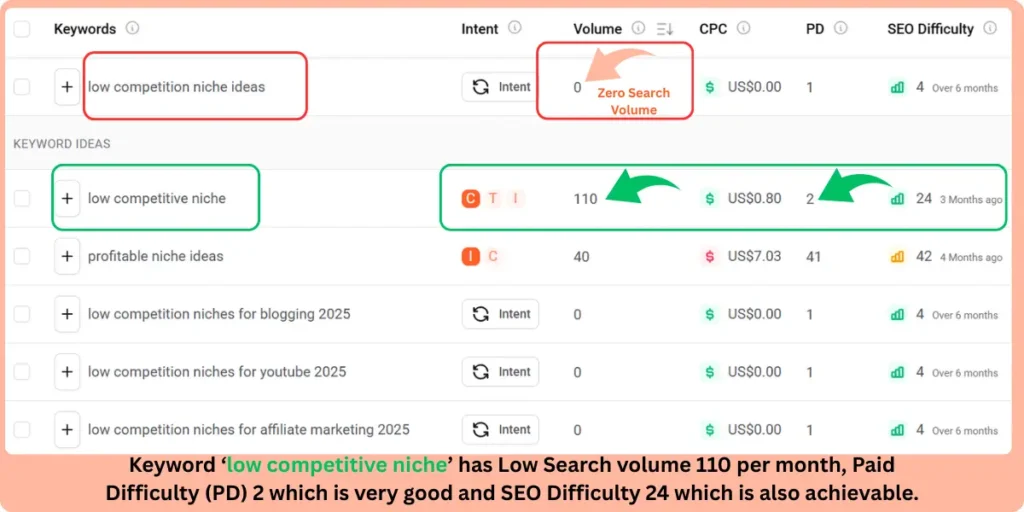
Sometimes, a small keyword change can make a big difference.
For example:
The keyword “low competition niche ideas” got almost zero visits.
But “low competitive niche” gets around 110 monthly searches with:
- PD: 2
- SEO Difficulty: 24
Same topic.
But very different traffic potential.
That’s why you should always check search volume before choosing long-tail keywords for your blog.
Free keyword research SEO tools like Ubersuggest allow you to check this using daily free searches.
These tools help you see:
- Search volume
- SEO difficulty
- Keyword ideas
All in one place.
Step 3: Check Who is Ranking
Now click on any keyword suggestion.
Look at:
- Blog titles
- Domain authority
- Type of websites ranking
If you see:
- Forums
- Small blogs
- Niche sites
That’s a good sign.
You can check competitor strength using:
👉 Check Domain Authority: Simple Guide for Beginners (Free Tools Included)
Step 4: Pick Beginner-Friendly Keywords
Choose keywords where:
- Difficulty is low
- Search intent is clear
- Content idea is specific
Avoid:
- Broad keywords
- Brand names
- Highly competitive topics
Over time, ranking for these small keywords can bring steady traffic.
Recommended Beginner Tools
Here are some tools you can try:
| Tool | Beginner Friendly | Free Option |
|---|---|---|
| Ubersuggest | Yes | Yes |
| SE Ranking | Yes | Trial |
| LowFruits | Yes | Limited |
| Ahrefs | Advanced | Paid |
| SEMrush | Advanced | Paid |
You can learn how to use these tools in detail:
👉 How to Use Ubersuggest for SEO and Skyrocket Blog Traffic Fast (Honest Review + Free Trial)
Finding the right keywords is the first step toward getting organic traffic. It helps you create content that matches real search demand.
Where Should You Use Keywords in a Blog Post?
Finding the right keyword is only the first step. Now you need to use it properly inside your blog post. This helps Google understand what your content is about and when to show it in search results.
Earlier, I used to add my keyword randomly inside the article. But that didn’t improve rankings. Later I learned that keyword placement matters more than keyword repetition.
You should use your main keyword in:
- Blog title
- URL
- First paragraph
- H2 headings
- Meta description
- Image alt text
This helps both readers and search engines understand your topic clearly.
For example, if your keyword is:
👉 low competition affiliate marketing niche
Then your:
- Title can include it
- URL can contain it
- Subheadings can reflect it naturally
You don’t need to repeat it many times. Just place it where it makes sense.
To learn this step by step, you can check:
👉 Mastering Keyword Placement for Better SEO Rankings
You can also explore:
👉 Keyword Optimization: A Simple Beginner’s Guide to Smarter SEO
Both guides explain how to place keywords without making your content look forced.
Proper keyword placement improves readability and helps search engines connect your blog post with user search queries.
LSI and Semantic Keywords Explained
Google no longer ranks content based on one exact keyword. It now tries to understand the full meaning and context of your content. That’s why using related terms helps your blog post rank better.
These related terms are often called:
- LSI keywords
- Semantic keywords
- Contextual phrases
For example, if your main keyword is:
👉 affiliate marketing niche
Then related terms may include:
- beginner niche ideas
- profitable blogging niche
- low competition niche
Using these naturally inside your content helps Google understand your topic more clearly.
You don’t need to force them into every paragraph. Just include them where they make sense in your headings or explanation.
To learn this in more detail, check:
👉 Semantic Keywords Guide for Beginners: Learn Simple SEO That Works
You can also follow this step-by-step guide:
👉 10 Simple Steps to Master LSI Keywords for SEO Success
Using related keywords improves topic coverage and increases your chance of ranking for multiple search queries.
Does Keyword Density Matter Anymore?
Earlier, SEO focused a lot on repeating the main keyword multiple times in a blog post. Many beginners still believe they need to use the keyword in every paragraph to rank.
I used to do the same thing in my early posts. But this often made the content hard to read and unnatural.
Today, Google looks at:
- Content clarity
- Topic relevance
- User experience
instead of keyword repetition.
You don’t need to maintain a fixed keyword density anymore. Instead, focus on:
- Writing naturally
- Using related terms
- Keeping the content helpful
If you want to understand this better, you can read:
👉 Does Keyword Density Matter Anymore? The Truth About Modern SEO
Avoid keyword stuffing. It can hurt your rankings and reduce readability for your visitors.
Best Keyword Research SEO Tools for Beginners
You can find keywords manually using Google suggestions and related searches. But keyword research tools make the process faster and easier. They help you check search volume, competition level, and ranking opportunity.
Some tools are very powerful but may feel expensive for beginners.
For example:
- Ahrefs
- SEMrush
These tools offer deep insights into keyword difficulty and competitor analysis. But as a new blogger, you may not need all these advanced features in the beginning.
Instead, you can start with beginner-friendly tools like:
✔ Ubersuggest
✔ SE Ranking
✔ LowFruits
These tools help you:
- Discover long tail keywords
- Analyze keyword difficulty
- Check competitor strength
- Find content ideas
Here’s a simple comparison:
| Tool | Beginner Friendly | Free Option |
|---|---|---|
| Ubersuggest | Yes | Yes |
| SE Ranking | Yes | Trial |
| LowFruits | Yes | Limited |
| Ahrefs | Advanced | Paid |
| SEMrush | Advanced | Paid |
Using the right tool can save time and help you focus on keywords that match your blog’s authority level.
Free vs Paid Keyword Research Tools for Beginners

Industry Standard
Advanced SEO Tool

Advanced Tool
Competitor Research

Free Plan
Beginner Friendly

Free Trial
Budget Option

Pay-as-you-go
Low Competition
As a beginner, you don’t need advanced data or expensive tools in the beginning. Tools like Ubersuggest, SE Ranking, and LowFruits can help you get started with keyword research for free or at a low cost.
You can see how these tools work here:
👉 How to Use Ubersuggest for SEO and Skyrocket Blog Traffic Fast (Honest Review + Free Trial)
Common Keyword Research Mistakes Beginners Make
When I started blogging, I made several keyword research mistakes without realizing it. These mistakes slowed down my progress and made it harder for my posts to rank.
One common mistake is choosing broad keywords that have high competition. These keywords may look attractive because of their search volume. But they are often dominated by established websites.
Another mistake is ignoring search intent. Sometimes a keyword looks relevant, but the user may be looking for something different from what your content offers.
Here are a few beginner mistakes to avoid:
- Targeting highly competitive keywords
- Writing without checking search demand
- Ignoring user intent
- Choosing topics based on guesswork
Avoiding these mistakes can save time and effort in the long run.
To learn more about common pitfalls, check:
👉 Avoid These 10 Affiliate Marketing Mistakes Beginners Always Make
Being aware of these mistakes helps you create content that has a better chance of ranking.
Final Keyword Research Workflow for Beginners
If you’re just starting out, keyword research may feel overwhelming at first. But once you follow a simple process, it becomes much easier to apply in your blogging routine.
Here’s a beginner-friendly workflow you can follow:
- Choose a topic related to your niche
- Find long tail keywords
- Check keyword difficulty
- Analyze competitor authority
- Create helpful content
- Optimize your blog post
This step-by-step approach helps you write content that matches real search demand. Instead of guessing blog topics, you create posts people are already looking for.
Once you find the right keyword, your next step is to turn it into a helpful blog post. If you’re not sure how to structure your first affiliate article, you can follow:
👉 How to Write Your First Affiliate Blog Post (Proven Beginner’s Guide)
With consistent effort, keyword research can help you build organic traffic over time.
Conclusion
Keyword research helps you connect your content with real people searching for solutions. It increases your chances of ranking even if your blog is new.
Start with low competition keywords and create helpful content around them. Over time, this builds trust with both your readers and search engines.
Consistency matters more than perfection. Keep learning and applying what works best for your blog.
FAQs
1. What is keyword research in SEO?
Keyword research is the process of finding what people are typing into Google before writing a blog post. It helps you choose topics that have real search demand instead of guessing what to write.
2. Can I do keyword research for free?
Yes. You can use free SEO tools like Ubersuggest, LowFruits, or AnswerThePublic to find keyword ideas, search volume, and SEO difficulty without paying anything.
3. How do beginners find low competition keywords?
Beginners can find low competition keywords by searching long-tail keywords like:
affiliate marketing side hustle
how to start blogging for free
best niche for beginner bloggers
These usually have lower SEO difficulty and are easier to rank.
4. Is keyword research necessary for blogging?
Yes. Without keyword research, your blog posts may target topics nobody is searching for. Keyword research helps you get organic traffic from Google by writing content people already need.
5. What is a good SEO difficulty score for beginners?
For new blogs, it’s better to target keywords with:
SEO Difficulty below 30
Paid Difficulty below 20
These keywords are easier to rank without backlinks.
6. Can I rank without backlinks using keyword research?
Yes. By targeting low competition long-tail keywords, beginner bloggers can get traffic even without backlinks in the beginning.
7. Which is the best free keyword research tool for beginners?
Beginner-friendly tools include:
Ubersuggest
SE Ranking (Free trial)
LowFruits (Pay as you go)
These tools help find achievable keywords for new blogs.
8. What are long-tail keywords?
Long-tail keywords are longer search phrases like:
👉 “how to do keyword research for free”
They usually have lower competition and are easier to rank compared to short keywords like “SEO”.