Dwell time is one of the most important signals that shows Google how helpful your content is. When someone clicks your page from Google, stays for a while, and then returns to the search results, Google measures how long they lasted. That time is called dwell time.
A longer dwell time tells Google that your page answered the user’s question. A short one tells Google the opposite. This is why it matters so much for SEO. When visitors stay on your page, Google sees your content as applicable, which can improve your rankings.
To understand how dwell time affects website SEO, think of it as a reflection of user satisfaction. If your content is easy to read, clear, and helpful, people naturally stay longer. When they stay longer, Google gets a strong signal that your content is relevant. This simple user behavior can play a big role in improving your search performance.
For beginners, dwell time is also one of the easiest engagement signals to improve. You don’t need coding. You don’t need advanced SEO. You only need a clean layout, readable content, helpful sections, and a page that feels good to use.
In this guide, we’ll break everything down so you can use it to strengthen your SEO and create a better experience for your readers.
Table of Contents
What Dwell Time Really Means
It is the time a visitor spends on your page before leaving for Google. It combines user experience and content quality into a single, simple metric.
It answers questions like:
- Did the visitor find what they needed?
- Did the content feel helpful?
- Did they enjoy reading?
- Did the layout feel comfortable?
- Did they scroll through the content?
Google uses it as a sign of satisfaction. When the time is high, your content has likely solved the user’s problem. When it is low, Google may show your content to fewer people.
How Dwell Time Affects Website SEO
It tells Google whether your page deserves a higher position. It doesn’t act alone; it works alongside other engagement signals, such as bounce rate, scroll depth, and pages per session.
Here’s why it matters:
- A longer staying time shows strong relevance
- People who stay longer are more likely to click internal links
- Longer sessions reduce bounce rate
- More engaged users signal to Google that your site offers value
- Google rewards pages that satisfy search intent
For beginners, improving dwell time is an easy path to better rankings because it focuses on satisfying real users rather than just search engines.
How Dwell Time Boosted My Website Ranking
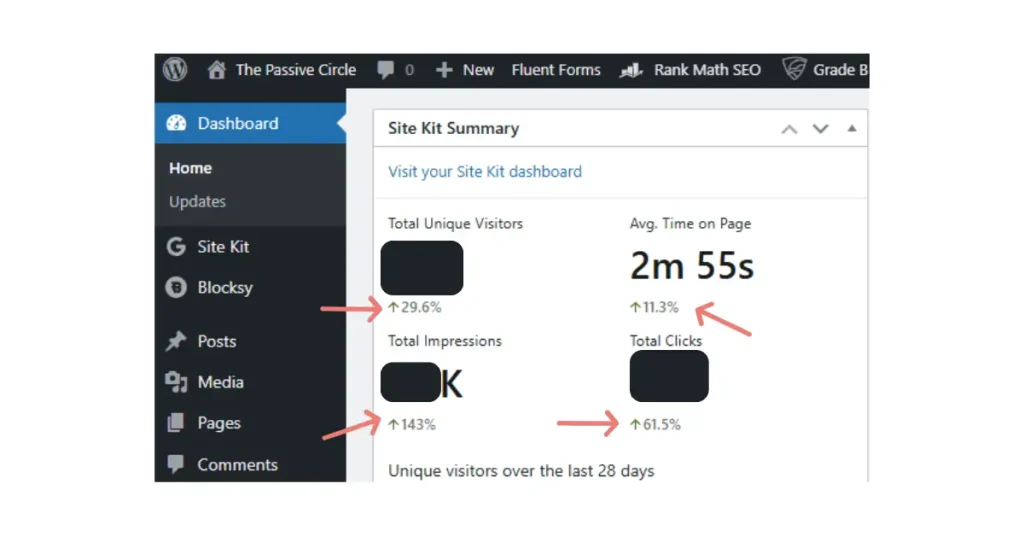
When I created my first SEO guide, people clicked the page but didn’t stay. My dwell time was low, and my ranking dropped over time.
When I looked closer, I noticed problems:
- The intro didn’t hook readers
- My paragraphs were too long
- There were no examples
- No images
- No internal links
- The layout felt heavy
Once I updated the guide with a cleaner layout, short paragraphs, real stories, and a substantial introduction that spoke directly to the user’s problem, everything improved. Visitors stayed 2–3 minutes instead of 20 seconds. The page began to rank again.
This taught me that engaging time isn’t about tricks. It’s about creating content that respects readers’ time and attention.
What Good and Bad Dwell Time Looks Like
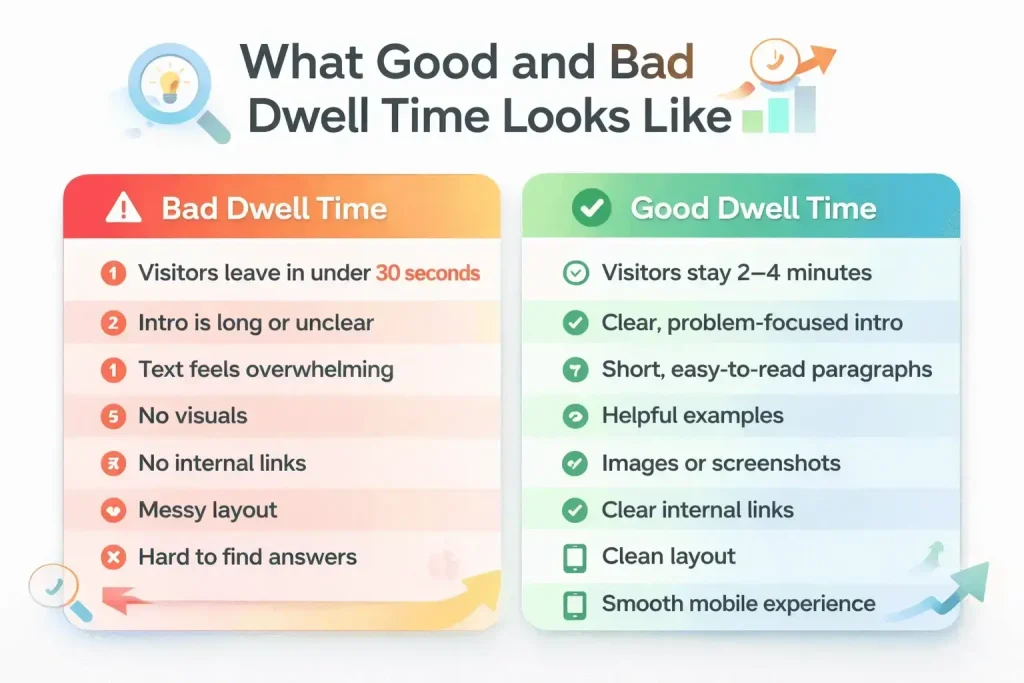
Before (Bad Dwell Time)
- Visitors leave in under 30 seconds
- Intro is too long or unclear
- Text feels overwhelming
- No visuals
- No internal links
- The layout seems messy
- The answer is complicated to find
After (Good Dwell Time)
- Visitors stay for 2–4 minutes
- Strong intro that speaks to their problem
- Short, easy-to-read paragraphs
- Helpful examples
- Screenshots or images
- Clear internal links
- Clean layout
- Smooth mobile experience
When visitors stay longer, Google sees your page as applicable, and your SEO gets stronger.
Key Factors That Improve IT
1. Clear and Engaging Introduction
Your intro should make readers feel understood.
For example:
“You want to improve your SEO, but you’re not sure why people leave your site so fast. Dwell time helps you understand that, and this guide explains everything in simple steps.”
A strong intro keeps users reading.
2. Clean and Readable Layout
People leave fast if the page looks messy or too crowded.
- Using short paragraphs
- Adding spacing
- Using simple language
- Adding clear headings
- Using larger fonts
- Breaking text into sections
Tools like Grammarly help improve clarity and sentence flow.
3. Add Helpful Examples
Examples keep readers engaged.
They help users understand the topic faster and relate to your content.
Good examples:
- Your own beginner experience
- Before/after comparisons
- Short case studies
- Real-life situations
Examples naturally increase time on the page.
4. Use Images, Visuals, and Screenshots
Visuals break the text and make the page easier to scan.
You can use Canva to create clean, lightweight images.
Screenshots are great when explaining tools or steps.
You may find this post helpful for image optimization: 9 Easy Image SEO Optimization Steps for Faster WordPress Blogs.
5. Add Internal Links to Related Posts
Internal links guide visitors to the next topic.
More page views mean better engaging time and stronger SEO.
Examples for your series:
- “Read the Mobile Optimization guide next.”
- “See how Page Speed improves user experience.“
Use PrettyLinks to keep URLs clean and professional.
6. Improve Mobile Experience
Most readers visit from their phones.
If your mobile version is hard to use, dwell time drops.
Fix mobile issues by:
- Using the Blocksy theme
- Checking the layout on your own phone
- Avoiding wide images
- Keeping pop-ups small
- Compressing images with Imagify
- Using Fluent Forms for mobile-friendly forms
When your mobile experience feels smooth, users stay longer.
7. Add Real Value
Dwell time increases when readers feel your content is worth their time.
This means:
- Answering the question clearly
- Giving actionable steps
- Keeping explanations simple
- Avoiding fluff
- Providing insights based on your own experience
People stay when the content feels helpful.
8. Use Strong CTAs
A strong call to action guides the user to the next step.
It also reduces early exits.
You can use:
- “Read the next guide.”
- “Download the checklist.”
- “Try the free version of Systeme.io.”
CTAs provide direction, increasing time.
Tools to Track and Improve Dwell Time
Google Analytics
Shows how long visitors stay on your page.
Ubersuggest
Ubersuggest helps me to track engagement patterns and top-performing content.
Search Console
Shows pages that get impressions but low engagement.
Canva
Helps you add visuals that improve stay time.
Imagify
Improves mobile speed, which directly boosts dwell time. I’m using Imagify and Tinypng for mobile optimizations and speed.
Blocksy Theme
Creates a clean layout that keeps users reading.
These beginner-friendly tools make it easier to understand and improve staying time.
Small Tutorials (Beginner-Friendly Steps)
How to Fix Low Dwell Time
- Improve your intro
- Break the text into short sections
- Add headings
- Add at least one image
- Add internal links
- Check your mobile layout
- Remove clutter
- Add a CTA at the end
These simple changes make users stay longer.
How to Add Internal Links the Right Way
Use simple, clear anchors like:
- “Learn more in the Page Speed guide.”
- “Next, read how CTR affects your SEO.”
This keeps users exploring your site.
How to Improve Readability Quickly
- Open your content in Grammarly
- Fix long sentences
- Add spacing
- Use simple language
- Break large paragraphs into smaller ones
Better readability means longer stay time.
Dwell Time Mistakes Beginners Should Avoid
- Long blocks of text
- Weak intros
- No visuals
- Too many pop-ups
- Slow loading pages
- Confusing mobile layout
- No internal links
- Overusing difficult words
Avoiding these mistakes can increase dwell time right away.
Why Google Values Dwell Time
Google wants to show the most helpful content for every search.
It helps Google understand:
- Did the user find the answer?
- Did the visitor read the content?
- Did they stay long enough to learn something?
- Did they explore more pages?
When visitors stay longer, Google sees your content as trustworthy.
When they leave quickly, Google may lower your rankings.
It works alongside CTR, engagement metrics, UX, and mobile optimization to build a strong SEO foundation.
Dwell Time Checklist Before You Publish
- Is the intro clear and engaging?
- Are paragraphs short and readable?
- Did I add helpful examples?
- Did I include at least one image or screenshot?
- Did I use simple, friendly language?
- Is the page clean and easy to scan?
- Did I add internal links?
- Is the mobile version smooth?
- Did I add a clear CTA at the end?
If yes, your dwell time will improve naturally.
FAQs: Dwell Time and SEO Explained
1. What is dwell time in SEO?
It is how long someone stays on your page after clicking it from Google, before going back to the search results. It helps Google see if your content meets what the user was looking for. If people stay longer, it usually means your page was helpful.
2. How does dwell time affect SEO?
It impacts SEO because it shows if users are happy with your page. If visitors stay, read, and scroll, Google sees your content as useful. If people leave quickly, your page might not rank as well.
3. Does time spent on a website affect SEO?
Yes, time spent on a website is closely related to dwell time and engagement. While Google does not confirm it directly, spending more time on the site usually means a better user experience, stronger engagement signals, and improved SEO performance over time.
4. What is a good dwell time for a website?
There is no perfect number, but generally:
Under 30 seconds is weak.
1–2 minutes is average
2–4 minutes or more is strong
Good dwell time depends on your content type. Blog posts and guides usually benefit from longer dwell time than quick answer pages.
5. What is the difference between dwell time and bounce rate?
Dwell time measures how long a user stays before returning to Google. Bounce rate measures whether a user leaves your site without visiting another page. A page can have a high bounce rate but still good dwell time if users stay long enough and get value.
6. Is it the same as bounce rate?
No. Bounce rate only tracks page exits, not time spent. It focuses on how long a user stays after clicking on search results. Dwell time gives deeper insight into content quality and relevance.
7. What is bounce rate in SEO?
Bounce rate shows the percentage of visitors who leave your site after viewing one page. A high bounce rate can be a problem if users leave quickly, but if they stay long and find answers, it may not hurt SEO.
8. How does dwell time relate to user experience?
A good user experience leads to longer time. Clear layout, readable text, fast loading speed, mobile-friendly design, and helpful content all encourage users to stay longer on your page.
9. What is dwell time on a website in simple terms?
In simple words, it shows how long people “hang around” on your page after clicking it from Google. If they stay and read, your stay time improves. If they leave fast, it drops.
10. What is dwell time vs bounce rate in SEO?
Stay time shows how long users stay. Bounce rate shows whether they leave after one page. Both help you understand user behavior, but dwell time gives better insight into content usefulness.
11. What is the 80/20 rule in SEO, and how does it relate to dwell time?
The 80/20 rule means 20% of your content often brings 80% of your results. Improving staying time on your top-performing pages can significantly boost overall SEO without updating every post.
12. Does dwell time matter for social media traffic?
It is mainly used for search traffic, but social platforms also track time spent on content. Longer engagement helps algorithms decide whether to show your content to more users.
13. How can beginners improve dwell time easily?
Beginners can improve dwell time by:
Writing clear introductions
Using short paragraphs
Adding headings and visuals
Improving page speed
Linking to related posts
Making content easy to read on mobile
Small changes can make a big difference.
14. Does longer content always improve dwell time?
Not always. Content should be as long as needed, not longer. Clear, helpful, and well-structured content keeps users longer than long but confusing pages.
15. Is dwell time a direct Google ranking factor?
Google has not confirmed dwell time as a direct ranking factor. However, it strongly reflects user satisfaction, which aligns with Google’s goal of ranking helpful content. Improving staying time almost always helps SEO indirectly.
Next Step
You’ve completed all the essential engagement-focused SEO guides. To build a stronger structure across your site, your next step is mastering internal linking:
👉 Read: Internal Links for Beginners: Simple Guide to Better SEO
This guide will show you how to build a strong SEO foundation that helps users and Google better understand your content.
If you’re interested in learning more about SEO, check out my Complete SEO Guide for a better understanding.
- How Does Web Hosting Work? What Happens When You Visit a Website?

- Best WordPress Hosting in Bangladesh: 5 Hosts Compared (2026)
- What Is BDIX Hosting? Does It Make Your Website Faster?

- How Much Does Web Hosting Cost in 2026? Hosting Prices Explained
- How to Choose Web Hosting: A Beginner’s Guide





Suggested Blog Posts
- The Ultimate Affiliate Marketing Guide for Beginners 2025 [Proven + Powerful Strategies]
- Systeme.io Ultimate Guide 2025: Login, Pricing, Features, Reviews, and How to Get Started
- ExonHost Review 2025: Best Hosting for Fast & Reliable Websites in Bangladesh
- 10 Simple Steps to Master Easy Table of Contents in Blocksy
- Blocksy Theme Review 2025: The Best WordPress Theme for Affiliate Bloggers
- How to Use Ubersuggest for SEO and Skyrocket Blog Traffic Fast (Honest Review + Free Trial)
- Avoid These 10 Affiliate Marketing Mistakes Beginners Always Make