When you start learning SEO, you will see two similar metrics everywhere. Domain Authority and Domain Rating. Domain Rating vs Domain Authority, yes they look almost the same. They both rate websites from 0 to 100. They both measure backlink strength. They both help you understand your site’s power.
But there is a big difference. Domain Authority and Domain Rating are created by different tools. They use different calculations. They sometimes give different numbers for the same website. If you want to track your SEO growth, it is important to know how they work and which one to follow. Let’s break it down in a simple way.
Table of Contents
What Is Domain Authority
Domain Authority is a score created by Moz. It predicts how likely a website is to rank on search engines. The score comes from many factors, like backlink quality, total linking domains, and trust signals.
Domain Authority is useful for beginners because it shows an easy overview of your website’s strength. You can check your score using any domain authority checker. There are also free domain authority checker tools online if you want quick results.
Domain Authority goes up slowly. You usually need more high-quality backlinks, better internal links, and a clean website to improve your score.
What Is Domain Rating
Domain Rating is a score created by Ahrefs. It focuses mainly on the strength of your backlink profile. It measures how many websites link to you and how strong those sites are.
Domain Rating reacts faster than Domain Authority. If you gain a few strong backlinks, your Domain Rating can jump quickly. You can check it with the Ahrefs Website Authority Checker or other free tools that read DR values.
Both DA and DR show the strength of your backlink profile, but Domain Rating is more focused on pure link power.
Key Difference Between Domain Rating and Domain Authority
Even though the scores look similar, the tools measure different things. Here is the simple breakdown.
Domain Authority (Moz)
- Predicts ranking potential
- Uses many signals, not only backlinks
- Updates slower
- More stable score
- Good for beginners
Domain Rating (Ahrefs)
- Focuses mainly on backlinks
- Updates faster
- Reacts quickly to new links
- Often used by link builders
- Good for understanding backlink strength
Even though both scores look similar, they measure different things. Here is a simple side-by-side breakdown.
| Feature | 🟧 Domain Authority (DA) | 🟦 Domain Rating (DR) |
|---|---|---|
| Created by | Moz | Ahrefs |
| Main purpose | Predicts ranking potential | Measures backlink strength |
| Core focus | Uses many signals, not only backlinks | Focuses mainly on backlinks |
| Update speed | Updates slower | Updates faster |
| Reaction to new links | Changes gradually | Reacts quickly to new links |
| Score stability | More stable over time | Can change often |
| Best for | Beginners and long-term tracking | Link builders and SEO audits |
| What it shows | Overall site strength | Backlink power |
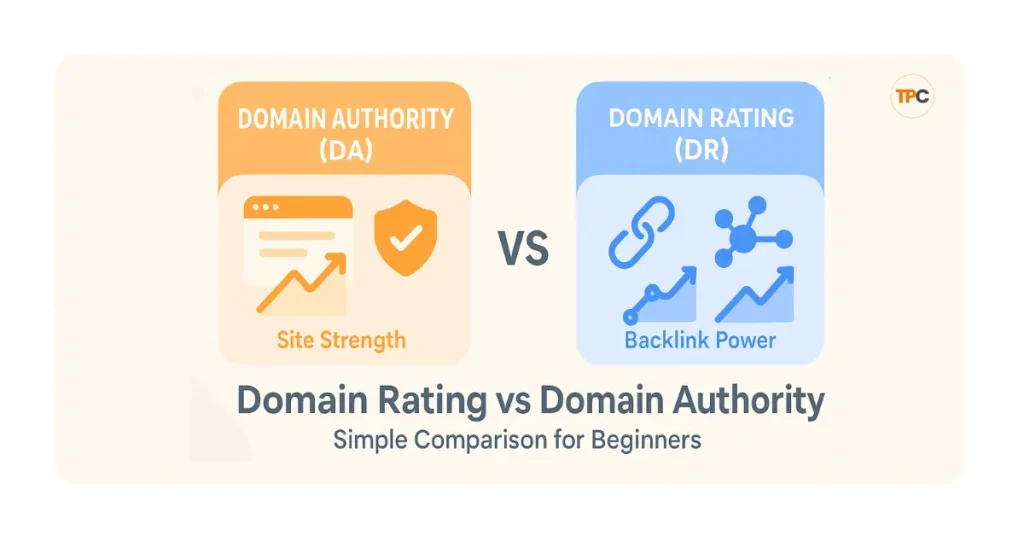
Simple Way to Remember
- Domain Authority = Website strength
- Domain Rating = Backlink power
Both scores are useful. They just serve different purposes. If you are a beginner, Domain Authority is easier to track. If you are focused on backlinks, Domain Rating gives faster feedback.
Do not compare DA with DR directly. Track one metric consistently and focus on improvement over time.
Domain Rating vs Domain Authority: Which One Should You Track
If you want a simple, beginner-friendly number to follow, Domain Authority is enough. It shows long-term growth and aligns well with slow, steady SEO progress.
If you want to study backlinks and measure how strong your link profile is, Domain Rating gives better insights. It helps you see which links made a real difference.
Many SEO experts track both metrics because they show different sides of your website’s growth. For beginners, choose one and stick with it. The trend matters more than the score.
How Is Domain Authority Calculated
Domain Authority uses a mix of signals. It looks at:
- Number of linking domains
- Quality of linking domains
- Site structure
- Trust signals
- Spam indicators
This score is not used by Google. It is only a calculated estimate. You can check how your number is created inside the domain authority calculator or any free online domain authority checker tool.
How Is Domain Rating Calculated
Domain Rating uses backlinks as the main factor. It looks at:
- Total number of linking domains
- Strength of those domains
- Distribution of dofollow backlinks
- Internal link structure inside linking sites
If a high authority site links to you, your DR increases. If you get many weak links, your DR stays the same or increases slowly.
Why Your Scores May Be Different
It is normal to see a Domain Authority of 15 and a Domain Rating of 25 for the same site. The tools use different formulas and different data sources.
Here are common reasons your numbers do not match:
- One tool finds more backlinks than the other
- The calculation formulas are different
- DR reacts faster to new links
- DA requires more consistent signals
- Tools update their databases at different times
Do not worry if the numbers are not equal. Focus on improvement, not perfection.
How to Improve Both Domain Authority and Domain Rating
The steps for improving both scores are similar because both rely heavily on backlinks.
Here is what works well for beginners.
- Build real, high-quality backlinks.
Guest posts, niche community mentions, and resource links help more than random backlinks. - Create content people want to reference
Guides, comparisons, and templates attract natural links. - Improve your internal links.
A clean structure helps Google understand your website. - Remove spammy backlinks
A backlink audit helps keep your site healthy. - Stay consistent with publishing.
Older, active domains tend to have stronger authority.
Both metrics rise slowly. Do not expect overnight changes.
Do High Domain Authority Sites Give Better Links
Yes. A backlink from high-domain-authority sites usually helps more because those sites already have trust and strong link profiles. They pass more value to your website.
But relevance matters too. A link from a small niche blog that matches your topic can be more powerful than a giant site that has nothing to do with your niche.
Aim for a mix of strong sites and relevant sites.
Want to find easy keywords without spending money?
Read this: How to Do Keyword Research for Free (Beginner Guide)
Final Thoughts
Domain Authority and Domain Rating are helpful for tracking your SEO progress, but they are not official ranking factors. They are tools. They guide you. They give you a picture of your growth.
Use them as indicators, not absolute rules.
Consistency and quality matter more than any score.
If you’re interested in learning more about SEO, check out my Complete SEO Guide for a better understanding.
Useful Resources to Check Domain Authority
If you want to check domain authority and understand how your website is growing, using trusted SEO tools is important. These tools analyze your backlinks and give you a score that helps you compare your site with others in your niche.
Below are some reliable tools beginners can use.
Moz Domain Authority Checker
Moz is the creator of Domain Authority Checker. Their tool shows your DA score along with linking domains and spam signals. It is simple and beginner-friendly.
Ahrefs Website Authority Checker
Ahrefs uses Domain Rating instead of Domain Authority, but it is still useful for understanding link strength. You can check basic metrics for free.
Semrush Authority Score
Semrush provides an Authority Score based on backlinks, traffic, and trust signals. It gives a broader view of your site health.
Free Online Domain Authority Checker Tools
There are also free tools that let you check domain authority quickly without creating an account. These are helpful for quick checks and comparisons.
Learn the Basics Before Using Any Tool
Before relying on scores, it is important to understand what Domain Authority really means and how to use it correctly. This beginner-friendly guide explains everything step by step.
- How Does Web Hosting Work? What Happens When You Visit a Website?

- Best WordPress Hosting in Bangladesh: 5 Hosts Compared (2026)
- What Is BDIX Hosting? Does It Make Your Website Faster?

- How Much Does Web Hosting Cost in 2026? Hosting Prices Explained
- How to Choose Web Hosting: A Beginner’s Guide





Suggested Blog Posts
- The Ultimate Affiliate Marketing Guide for Beginners 2025 [Proven + Powerful Strategies]
- Systeme.io Ultimate Guide 2025: Login, Pricing, Features, Reviews, and How to Get Started
- ExonHost Review 2025: Best Hosting for Fast & Reliable Websites in Bangladesh
- 10 Simple Steps to Master Easy Table of Contents in Blocksy
- Blocksy Theme Review 2025: The Best WordPress Theme for Affiliate Bloggers
- How to Use Ubersuggest for SEO and Skyrocket Blog Traffic Fast (Honest Review + Free Trial)
- Avoid These 10 Affiliate Marketing Mistakes Beginners Always Make