This post may contain affiliate links. If you purchase through these links, I may earn a small commission at no extra cost to you. Read our full Affiliate Disclosure

How do you write your first affiliate blog post?
Should it be a review? A tutorial? Or a simple guide?
My biggest mistake was waiting too long to write my first affiliate blog post.
I kept learning. I kept planning. I didn’t publish.
That delay cost me months.
The good news?
You don’t need to overthink this.
There’s a simple framework that works for beginners.
I used it myself.
And I’ll walk you through it step by step.
Table of Contents
Why your first affiliate blog post matters
Writing your first affiliate blog post as an affiliate can feel overwhelming. Most beginners get stuck because they don’t know where to start. Should you focus on SEO? Should you just start writing and hope it works? Or should you copy what other bloggers do?
Your first affiliate blog post is crucial. It lays the groundwork for all your future content. If you get it right, you’ll build trust, start attracting readers, and open the door to affiliate income. If you skip it or do it in a hurry, you’ll likely waste time and struggle to see results.
So, it’s important to slow down. Follow a step-by-step affiliate marketing guide. Build something solid from day one.
What Your First Affiliate Blog Post Really Is
First affiliate blog post is a useful article. You recommend a product, tool, or service. Then, you add your affiliate link. When readers click your link and make a purchase, you earn a commission.
But here’s the part beginners often miss:
- It’s not just about dropping links everywhere.
- It’s about solving a real problem for your audience.
- It’s about showing them why the product matters and how it helps.

For example:
- A simple blog tutorial on affiliate marketing can show beginners how to set up an email list with ConvertKit. You can include your affiliate link in a natural way.
- An affiliate product review blog post could break down the pros and cons of a tool you actually use.
In short: a good affiliate blog post feels like advice from a friend, not a sales pitch.
Why Beginners Often Struggle With Their First Affiliate Blog Post
If you’ve ever stared at a blank page for hours, you’re not alone. Many beginners find their first affiliate blog post tough due to three main reasons:
- Fear of sounding salesy – You don’t want to push products like a salesperson.
- Not knowing the structure – Without a clear outline, your post can feel messy.
- Output: Striving for perfection – New bloggers often overanalyze each word. Instead, they should focus on being helpful.
Here’s what I learned from my own journey: your first post won’t be perfect, and that’s okay. What matters most is that you start, keep it clear, and make it genuinely useful for readers.
How a Good First Post Builds Trust and Income
A well-written first affiliate blog post for beginner’s does two things at once:
- Builds Trust: Readers see that you’re offering honest and valuable advice. You’re not just throwing in links, you’re showing them solutions.
- Generates Income: When people trust your recommendations, they’ll click your affiliate links.
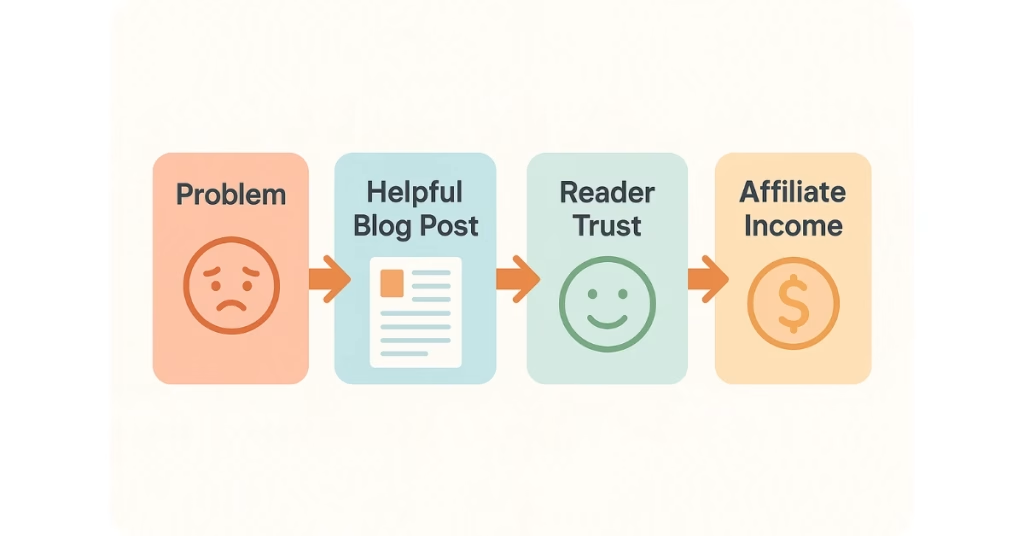
Think of it like this: your blog is a long-term relationship. That first post is the handshake. If you get it right, readers will stick around, share your content, and even buy through your links.
Don’t overcomplicate your first affiliate blog post. Focus on being clear, helpful, and honest. That’s the best way to earn trust and eventually commissions.
Step 1 – Pick the Right Niche and Product
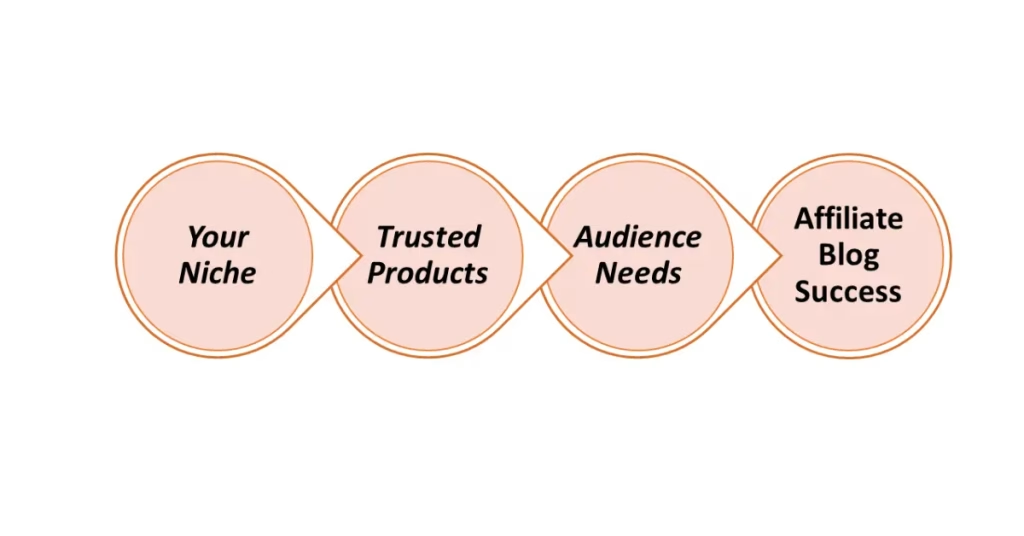
Before you can write your first affiliate blog post, you need to make sure you’re in the right lane. A great post doesn’t start with fancy SEO tricks. It starts with knowing your niche and picking a product that actually fits.
This is where most beginners go wrong. They grab any program with high commissions and hope people click. But if the product doesn’t match your audience, it’s like trying to sell steak at a vegan festival. No one’s buying.
Know Your Niche Before You Promote
From my blogging journey, I learned a crucial lesson: random affiliate blog post hurt trust.
If you’re launching a blog about affiliate marketing for beginners, be careful. Don’t post about “best luxury watches” without a warning.” This will confuse your readers and Google.
Your niche tells both your audience and search engines what your blog is about. Stay consistent.
For example:
- Promote plugins, themes, hosting, and SEO tools if your blog is about WordPress and blogging tools.
- If your blog covers personal finance, share budgeting apps, side hustle courses, or savings tools.
Your niche is your foundation. Pick products that naturally sit inside it, not outside.
Find Your Profitable Affiliate Niche (Low-Competition Guide for Beginners)
Choose a Product You’d Recommend to Your Best Friend
Here’s a golden rule from my frst affiliate blog post that make money: if you wouldn’t tell your best friend to buy it, don’t promote it.
Readers can smell fake recommendations a mile away. If you’re only pushing a product because it pays a high commission, you’ll lose trust fast.
Instead, choose products you:
- Already used or have tested.
- Truly believe it will help your readers.
- Would feel proud to stand behind, even if you earned $0.
I began by promoting free keyword research software and simple email marketing tools. I chose these not for the big payouts, but because they were beginner-friendly and I used them myself.

Always imagine sending your post to your closest friend. If you’d hesitate to recommend the product, don’t waste time writing about it.
Check What Your Audience Actually Wants
Before you start typing, pause and ask: What is my reader searching for right now?
Your blog post should solve a problem your audience already has. That’s the fastest way to make your first affiliate blog post helpful, instead of pushy.
Ways to find what your audience wants:
- Google it: Type your topic and check “People Also Ask” questions.
- Forums/Reddit/Quora: Look at real questions people are asking.
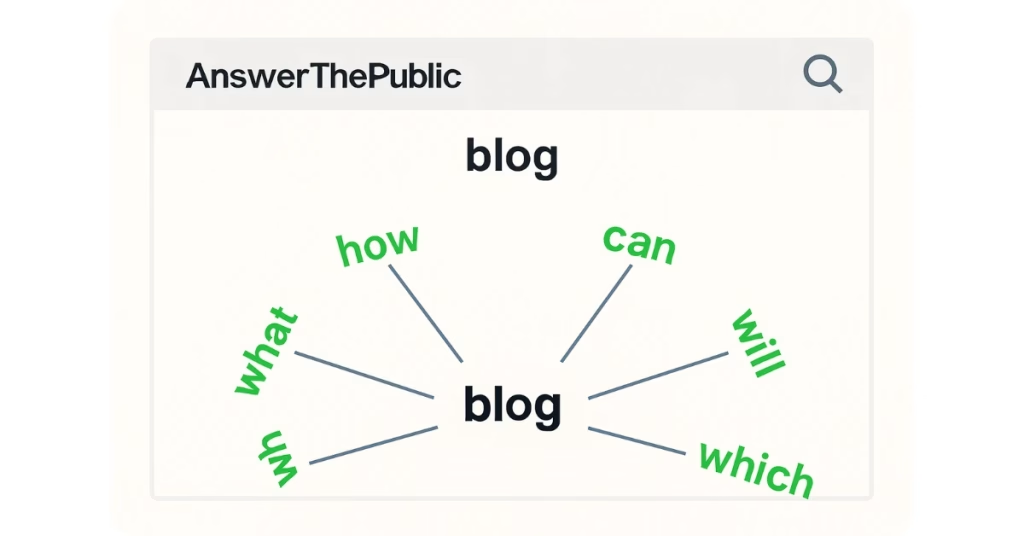
- Keyword tools: Even free ones like Ubersuggest or AnswerThePublic show what beginners are searching for.
For example:
- To add affiliate links naturally, follow these steps:
- Choose Relevant Products: Pick products that fit your content and audience.
- Create Quality Content: Write helpful, engaging posts that provide value.
- Integrate Links Smoothly: Insert links where they make sense in your text.
- Be Transparent: Let readers know when you use affiliate links.
- Use a Linking Tool: Try PrettyLinks to manage your links easily.
- You can add affiliate links by following these steps. This won’t disrupt your content flow.
- If they want an affiliate blog post example, show your own and explain why it works.
Write for your reader’s needs, not just for commissions. If you answer their questions, clicks and conversions will follow.
Before writing anything, make sure your blog is ready.
This part doesn’t need to be perfect.
It just needs to work.
Step 2 – Before You Write: Set Up Your Blog the Right Way
When I started, setting up a blog felt scary. I had no tech skills. But I learned one simple step at a time. You can do the same. A blog is the base of your affiliate marketing guide for beginners journey.
Quick Steps to Start Your Blog
1. Buy a domain and hosting
Pick a name you like and get hosting. It takes a few minutes.
2. Install WordPress
Most hosting sites have one-click install. It is easy.
3. Install the Blocksy Theme
It is fast, clean, and beginner-friendly.
4. Add the RankMath SEO plugin
It helps with SEO and keywords. It keeps things simple.
5. Create basic pages
Make these pages first:
- Privacy policy
- Terms page
- Contact page
6. Publish your first 3 blog posts
Share your story. Help beginners. Be honest and real. That is how we grow.
Step 3 – Do keyword research as a beginner
To make your first affiliate blog post attract readers, you must use the right keywords. Keywords connect what people search on Google to the content you create.
Without the right keywords, your blog post is just a diary entry. With the right keywords, it becomes a solution people are actively searching for.
Difference Between Informational and Transactional Intent
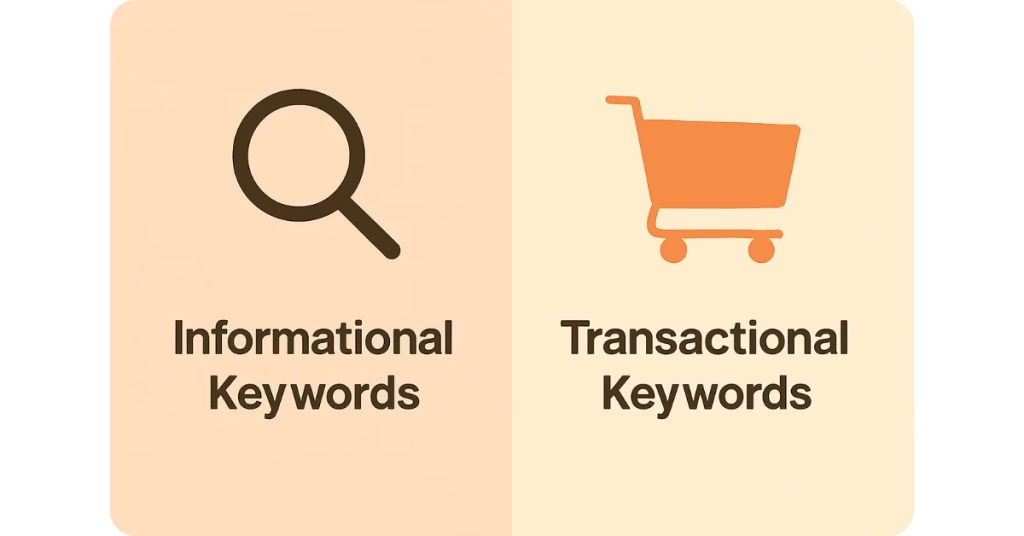
When you do keyword research, don’t just look at numbers. Look at intent: the “why” behind the search.
- Informational intent: The reader is looking to learn.
- Example: “What is an affiliate blog post?” “affiliate marketing step-by-step guide.”
- Best for tutorials, guides, and beginner-friendly content.
- Transactional intent: The reader is ready to take action.
- Example: “best email marketing tool for beginners,” “buy hosting with free domain.”
- Best for product reviews, comparisons, and recommendation posts.
If you’re writing your first post, start with informational keywords. They’re easier to rank for, and they build trust. When your audience trusts you, add transactional keywords. This can help you earn commissions.
Here is a tips from my first affiliate blog posts: I don’t start with “buy now” keywords. Instead, I write helpful posts that solve problems. Then, I add affiliate links where they fit.
Always match your post to the reader’s intent. Teach first, recommend second.
Use Free Tools (Google Keyword Planner, Answer the Public) and Paid Ones (Ahrefs, SEMrush)
You don’t need to spend hundreds on tools when you’re just starting out. Here’s a simple mix that works:
Free Tools for Beginners:
- Google Keyword Planner → Great for seeing search volumes and keyword ideas.
- Answer the Public → Shows you real questions people ask (perfect for headings).
- Ubersuggest → Easy keyword data and some competition info.
- Google Autocomplete → Type your topic into Google and note the suggestions.
Paid Tools (when you’re ready):
- Ahrefs → My favorite for finding keyword difficulty and content gaps.
- SEMrush → Excellent for competitor analysis and keyword clusters.
- Keysearch (cheaper, beginner-friendly) → I used this early on and still recommend it.
I usually begin with free tools for ideas. Then, I check the difficulty using Ahrefs. Even now, I don’t chase the biggest keywords. I look for the ones I can realistically rank for.
Start free, learn the basics, then upgrade when you have traffic and income to justify it.
Focus on Low-Volume, Low-Competition Long-Tail Keywords
Many beginners make a big mistake. They target broad and competitive keywords like “affiliate marketing.” Bad move. You’ll be competing with giants.
Instead, target long-tail keywords. These are longer, more specific searches like:
- “beginner’s guide to writing first affiliate blog posts”
- “how to add affiliate links naturally in WordPress”
- “best affiliate blog structure for beginners”
- “affiliate disclosure example for blogs”
These may only get 50–200 searches a month, but they’re gold because:
- They’re easier to rank for.
- Readers searching for them have a clear intent.
- They bring in traffic that’s more likely to click and buy.
Tips from my first affiliate blog post: My best posts don’t always get thousands of pageviews. They’re the smaller ones answering very specific questions. That’s where beginners win.
Don’t chase volume. Chase intent. 100 readers with buying intent are better than 10,000 readers who are just curious.
Find my exclusive keyword research guide here: How to Use Ubersuggest for SEO and Skyrocket Your Blog Traffic (Honest Ubersuggest Reviews)
Step 4 – Structure your first affiliate blog post
The truth is, most people don’t read blog posts word for word. They scan. That’s why structure matters as much as the words you choose. A messy, wall-of-text blog turns readers away. A clear post keeps readers interested and boosts clicks on your affiliate links.
When you write your first affiliate blog post, think of it as building a house. Headings are the frame. Paragraphs are the walls. Examples and visuals are the furniture that make it feel like home.
Write an Outline (H2, H3 Headings Make Posts Scannable)
Your outline is your roadmap. Without it, you’ll ramble. With it, you’ll guide your reader step by step.
Here’s a simple outline I use:
- H2 – The Big Idea or Step (keeps the flow clear)
- H3 – Breakdowns or Sub-steps (answers specific questions)
- Bullets and lists (make content easy to skim)
First Affiliate blog post example structure:
- Intro (why the topic matters)
- H2: Step 1 (problem) → H3s (solutions or sub-points)
- H2: Step 2 (action) → H3s (examples, tips, tools)
- H2: Wrap-up (summary + call-to-action)
I never start writing blind. I jot down my headings first, even if they’re rough. It gives me a skeleton to work with and makes writing ten times faster. I used ChatGPT to research and Blog Outlines.
Always outline before you write. It keeps your blog clean, scannable, and SEO-friendly.
Use a Friendly, Problem-Solving Tone (Talk to Readers Like a Best Friend)
Your readers aren’t looking for a lecture. They want a friend who’s one step ahead, sharing what works. That’s why your tone matters as much as your keywords.

Affiliate Blog Writing Tips to sound friendly:
- Write in the second person (“you” and “your”).
- Use short sentences.
- Share small mistakes or wins from your own journey.
Example: Instead of writing:
“Affiliate blog posts must be written in a structured manner to increase conversions.”
Say:
“Think of your affiliate blog post like a conversation with your best friend. Keep it simple, solve their problem, and show them the tools that actually help.”
My readers stick around because I sound like me, not a textbook. I share the exact struggles I had as a beginner and that makes my content relatable.
Write like you’re texting a friend. Be real. Be helpful. That’s how you build trust.
Add Examples, Lists, and Visuals for Clarity
Nothing kills a blog faster than endless paragraphs. Break things up with examples, lists, and visuals. This makes your content easier to read and more memorable.
Ways to do this:
- Examples → Show a sample affiliate blog intro, or a snippet of how you’d add an affiliate disclosure.
- Lists → Use bullet points to highlight tips, mistakes, or tools.
- Visuals → Add screenshots of keyword tools, flowcharts of affiliate funnels, or product images.
How I Write Affiliate Blog Posts That Make Money:
- I include screenshots of the tools I use.
When readers see real proof, they trust me more and click my links.
When I wrote my first affiliate blog post, I stopped thinking about money.
I focused on helping one beginner solve one problem.
I didn’t try to sound smart.
I didn’t try to sell hard.
I wrote the post I wish I had read when I was starting.
That mindset changed everything.
Honest content builds trust. Trust leads to clicks. Clicks lead to income.
Don’t just tell. Show. Use lists, examples, and images so your post feels alive, not like homework.
Step 5 – Add affiliate links naturally
Affiliate links are the bridge between your helpful content and your income. But here’s the thing: if you shove them in every sentence, readers run. If you hide them so well that no one sees them, you lose money.
The key is balance: place links where they naturally fit, be upfront about them, and make them easy to click.
Where to Place Affiliate Links (Within Helpful Context, Not Forced)
Don’t think of affiliate links as ads. Think of them as recommendations in the middle of a conversation.
Good places to insert links:
- Within tutorials: Step 2: Sign up for [Tool Name] here → link to affiliate product.
- If slow hosting is a problem for you, try [Hosting Name].
- In comparison lists: Side-by-side products with links to each.
- In CTAs (calls-to-action): “ Try [Tool Name] for free here.”
Avoid dumping affiliate links in every other line. One or two well-placed links in a 1,500+ word post can perform better than 10 scattered ones.
Again from my affiliate blog posts: I only add affiliate links that solve a problem I’ve mentioned. That way, the link feels like part of the solution, not a random sales pitch.
Place links where readers are already thinking, “Okay, what’s the next step?”
Use Clear Affiliate Disclosures for Trust

Google and the FTC both require affiliate disclosures. But more importantly, readers trust you more when you’re upfront.
Keep it simple. Place a disclosure near the top of your post, like:
“This post contains affiliate links. That means I may earn a commission if you purchase through my links, at no extra cost to you. I only recommend tools I personally use and trust.”
Also, add a permanent Affiliate Disclosure page in your blog footer.
How I Write Affiliate Blog Posts That Make Money: I’ve found that clear disclosures can boost conversions. In fact, they build credibility because readers know I’m being honest.
Don’t hide your affiliate links. Be upfront, and your audience will respect you more.
Link Internally to Related Blog Posts
Your affiliate links aren’t the only links that matter. Internal links are gold for both SEO and user experience.
Ways to use them:
- Link to posts that offer more detail, like “Check out my beginner’s guide to keyword research.”
- Link to related reviews (e.g., “I also reviewed [Another Tool] here”).
- Create a “hub” by linking back to your Start Here or “Affiliate Marketing for Beginners” page.
Why it works:
- Readers stay longer on your site → Google rewards this.
- Readers build trust through multiple posts before clicking your affiliate link.
I always link back to older posts. This keeps readers moving around my site. More movement means more clicks and conversions over time.
Use a mix of affiliate links + internal links. Both help your blog grow and earn.

Step 6 – Optimize for SEO and Readability
You can write the most helpful post in the world, but if no one finds it, it won’t make you a dime. That’s why SEO (Search Engine Optimization) matters. The goal isn’t to “hack Google.” Instead, aim for clarity. Make your post relevant and easy to read for both search engines and real people.
Add Main Keywords in Title, URL, H1, Early Intro, and Meta
Google looks for clues that your content matches a reader’s search. Those clues are your keywords.

Here’s how to place them naturally:
- Title & H1: Include your main keyword e.g., “Beginner’s Guide: How to Write Your First Affiliate Blog Post (Step-by-Step).”
- URL: Keep it short and keyword-rich e.g., /write-your-first-affiliate-blog-post/
- Intro (first 100 words): Mention your main keyword once, in a natural way.
- Meta Title & Description: Write a human-friendly snippet with your keyword in it.
Example Meta Description: “Learn to write your first affiliate blog post in a few easy steps. Use simple tips, examples, and structure to help you rank and earn.”
I never stuff keywords. I use the main keyword in key spots above. I add variations, such as “affiliate blog post example” and “affiliate blog writing tips,” throughout the post.
Use your keywords like salt, sprinkle them, don’t dump them.
Use Alt Text for Images and Proper Internal Linking
Images aren’t just eye candy, they’re SEO opportunities. Google can’t “see” images, but it reads the alt text.
Best practices:
- Describe the image clearly: Use a screenshot of Google Keyword Planner showing search volume for long-tail keywords.
- Slip in a keyword naturally when relevant: “affiliate blog post outline example.”
And don’t forget internal linking (we touched on this in Step 4):
- Link to your older posts with anchor text that matches their topic.
- Example: “If you’re stuck on keyword research, check out my full beginner’s guide to SEO basics.”
In my first affiliate blog post, I include alt text for every image. I also link to 2–3 of my older posts. This keeps readers moving around my site and shows Google my content is connected.
Every image and link is a chance to boost SEO. Don’t waste it.
Keep Sentences Short and Active Voice for Readability
Here’s the part most bloggers ignore: readability. Google measures how long people stay on your page. If your post is a giant wall of text, readers will bounce and Google notices.

Affiliate Blog Writing Tips for readability:
- Short sentences. Aim for 15–20 words max.
- Break up text. Use H2s, H3s, and bullet points.
- Active voice. Instead of “Affiliate links should be placed naturally,” write “Place affiliate links naturally.”
- Simple words. Don’t say “utilize” when “use” works.
I read my drafts out loud. If it sounds awkward, I cut it. That’s how I keep posts conversational and easy to follow.
Write like you talk. If a 12-year-old could read it, you’re on the right track.
Step 7 – Publish, promote, and track results
Hitting “publish” is a big moment. But if you stop there, your post won’t go far. A blog needs promotion and smart tracking to turn into income. Think of it as planting a seed. Publishing is the planting. Promotion and tracking are the watering and sunlight.
Share on Social Media, Email, and Forums

Don’t wait for Google alone to bring you traffic. Get your content out there where people already hang out.
Ways to share:
- Social Media:
- Twitter/X → Share a quick tip from your post with the blog link.
- Facebook Groups → Share your blog in groups where beginners seek affiliate marketing tips. Just avoid spamming.
- Pinterest → Create pins with blog graphics — it’s still a goldmine for traffic.
- Email:
- Send your post to your email list, even if it’s tiny.
- Example subject: “I just wrote my first affiliate blog post (here’s how you can too)”
- Forums/Communities:
- Reddit (r/affiliatemarketing, r/blogging).
- Quora → Answer a beginner’s question, then link back to your post for full details.
I always give value first when sharing. For example, on Facebook, I’ll post a short tip, then say: “If you want the full step-by-step guide, I’ve broken it down here [link].” That way, it feels natural, not spammy.
Promote your blog by leading with value, not just dropping links.
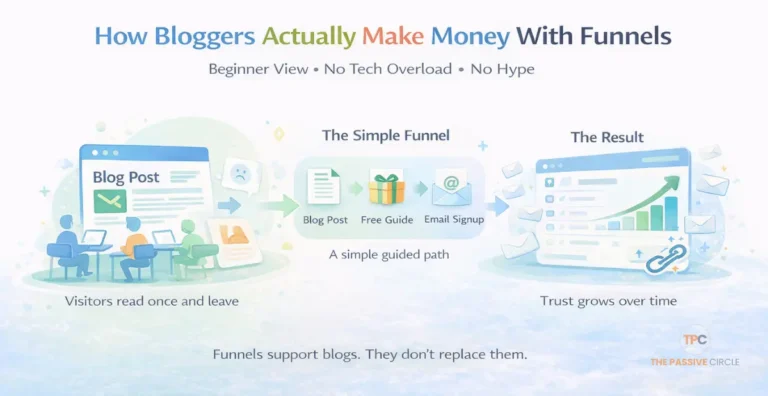
Writing posts is only step one. This blogging funnel for beginners shows what happens after someone reads your blog.Track Metrics: Traffic, Clicks, Conversions

Once your post is live, don’t just forget about it. Use tools to see what’s working.
Key metrics to watch:
- Traffic: How many people visit your post (Google Analytics)?
- Clicks: Track how many people click your affiliate links. Use PrettyLinks or ThirstyAffiliates for this.
- Conversions: How many sales or sign-ups come from those clicks (your affiliate dashboard)?
Even if the numbers are small at first, this data tells you which posts and links are worth focusing on.
My first affiliate blog posts that make money had low traffic. Still, I tracked clicks. I noticed people clicked on tools I casually mentioned in a tutorial more than ones I pushed hard. That showed me what readers actually wanted.
Pay attention to the data. It shows you what your audience values most.
Keep Tweaking Until It Converts
No blog post is ever “done.” The best affiliate marketers update and improve posts over time.
Ways to tweak:
- Update outdated screenshots or stats.
- Try new CTAs (e.g., “Try this tool free” vs. “Start your free trial”).
- Add more internal links as you publish new related posts.
- Improve formatting if the bounce rate is high (use more H2s, shorter paragraphs).
Some of my posts didn’t make a single sale in the beginning. After updating the intro and tightening the CTA, they added better visuals. Then, they began to convert. Persistence pays.
Treat every post like a living asset. Keep improving, and conversions will come.
Affiliate marketing isn’t about shortcuts. It’s about being helpful, consistent, and trustworthy. If you stick to that, clicks and commissions will follow.
Your next step:
- Pick one product or tool you believe in.
- Outline your first affiliate blog post using the steps above.
- Hit publish, even if it feels rough.
Want extra help? Grab my Beginner’s Affiliate Starter Toolkit so you never miss a step. And check out my full affiliate marketing step-by-step guide for beginners.
You’ve got this. Start simple, write like you’re helping a friend, and keep showing up. That’s how successful affiliate blog post are built.
FAQs for beginners
How long should my post be?
Aim for at least 1,500–2,500 words if you’re writing a full guide or review. Google usually ranks detailed posts higher. Readers also trust you more when you provide all the information they need. Short posts (under 800 words) often have trouble ranking. This is especially true if you’re not answering a specific question. My top posts are about 2,000 words. This length is helpful. I break them into short sections, making them easy to read.
Do I need personal experience with the product?
Not always, but it helps a lot. Readers trust you more if you can say, “I’ve used this tool myself.” If you don’t have experience, you can still write about it by doing deep research. Reading real user reviews. Watching tutorials or demos. But be honest about it. Don’t pretend you’ve used a product if you haven’t.
How soon can I make money from affiliate blogging?
Most beginners earn their first commission in about 3 to 6 months. This requires consistent posting and promoting. It depends on your niche, keywords, and traffic. Affiliate marketing is not instant money, it’s a slow build. My first sale came after months of posting, not days. But once it happened, I knew it was possible, and momentum built from there.
Should I start with a review post or a tutorial?
Start with a tutorial or guide. Reviews are great, but they’re harder to rank because big sites dominate them. Tutorials let you teach and naturally recommend tools, which is easier for beginners.
How many affiliate links should I add in one post?
Quality beats quantity. 2–5 links in a 1,500+ word post is usually enough. If every paragraph has a link, readers will feel like you’re pushing too hard.
What’s the best way to disclose affiliate links?
Keep it short and upfront. Place a note near the top, like: “This post contains affiliate links. I may earn a commission if you buy through my links at no extra cost to you.” You can also add a full Affiliate Disclosure page in your blog footer for legal safety.
Can I use free tools to write and optimize my post?
Yes! Start free. Beginners can use Google Docs for writing. They can use Grammarly to proofread. For keywords, tools like Ubersuggest and AnswerThePublic are helpful. They’re more than enough to get started. Upgrade later when you’re ready.
Do I need images in my first affiliate blog post?
Yes. Images break up text and make your post more engaging. Use screenshots, infographics, or stock photos. Always add alt text for SEO.
Should I promote just one product or multiple?
As a beginner, stick to one main product per post. Otherwise, readers get overwhelmed. Later, you can create comparison posts that cover multiple products.
What if my first affiliate blog post doesn’t rank or make sales?
That’s normal at the start. Go back, improve your SEO, add more examples, and promote it again. Think of your posts as living assets, update them until they work. Some of my early posts didn’t rank for months. Then I updated the title, included stronger keywords, and enhanced the formatting. As a result, they began to see more clicks and conversions.
How do I measure success in affiliate marketing?
Track clicks, conversions, revenue. Use tools like Google Analytics and Affiliate dashboards. Look for growth, not instant riches.
What is the best platform for affiliate marketing beginners?
There’s no “best” platform. You should pick one you are comfortable with (blog, YouTube, Pinterest) and focus on it.
What is high-ticket affiliate marketing?
It means promoting high-price offers where your commission is large. It can earn more but also takes more effort.
Do I need to disclose I use affiliate links?
Yes. It’s both ethical and often required by law. You should tell your audience you may earn a commission.
What is SEO and why is it important?
SEO means search engine optimization. It helps your blog/content show in Google. More visibility = more traffic.
What is cookie duration in affiliate marketing?
It’s how long the merchant will track the clicks from your link so you get credit if someone buys later.
Final thoughts and next steps
Writing your first affiliate blog post can feel tough, like climbing a mountain. But take it step by step, and it gets easier. You’ve learned how to:
- Pick the right niche and product that truly fits your audience.
- Do keyword research that helps your post get found.
- Structure your blog like a pro using clear H2 and H3 headings.
- Insert affiliate links naturally (without being pushy).
- Optimize for SEO and readability so readers stay engaged.
- Promote your post and track what’s working, then keep improving.
Here’s the thing: your first post won’t be perfect. That’s okay. Mine wasn’t either. But what matters is that you start. Each blog you write is practice, and each one gets better.
Download Your Free Affiliate Marketing Starter Toolkit
I know how hard it feels to begin with no direction. So I made a simple toolkit to help you start fast as a beginner. It has the basics you need to take your first steps with confidence.
Inside the toolkit, you will get:
- Niche selection cheat sheet
- List of 10 high-paying affiliate programs
- Blog and YouTube content planner
- Simple funnel map PDF
- Beginner SEO basics guide
This toolkit is made for beginners like us. No complicated stuff. Just easy steps you can follow today.
Resources I Personally Trust While Learning
When I started, I ignored hype and focused on learning from trusted sources.
Here are a few places I still learn from as a beginner:
- Google Search Central
Helps me understand how Google works. No shortcuts. Just real guidance. - Moz Beginner SEO Guide
Simple explanations that helped me understand SEO without confusion. - Ahrefs Blog
Clear examples of how blogs grow traffic and income over time.
I don’t follow hype. I follow clarity.