Before I built The Passive Circle, I spent a weekend just trying to understand one thing: what does “affiliate marketing” actually mean, in plain terms, without the hype?
This guide is the answer I wish I had found on day one.
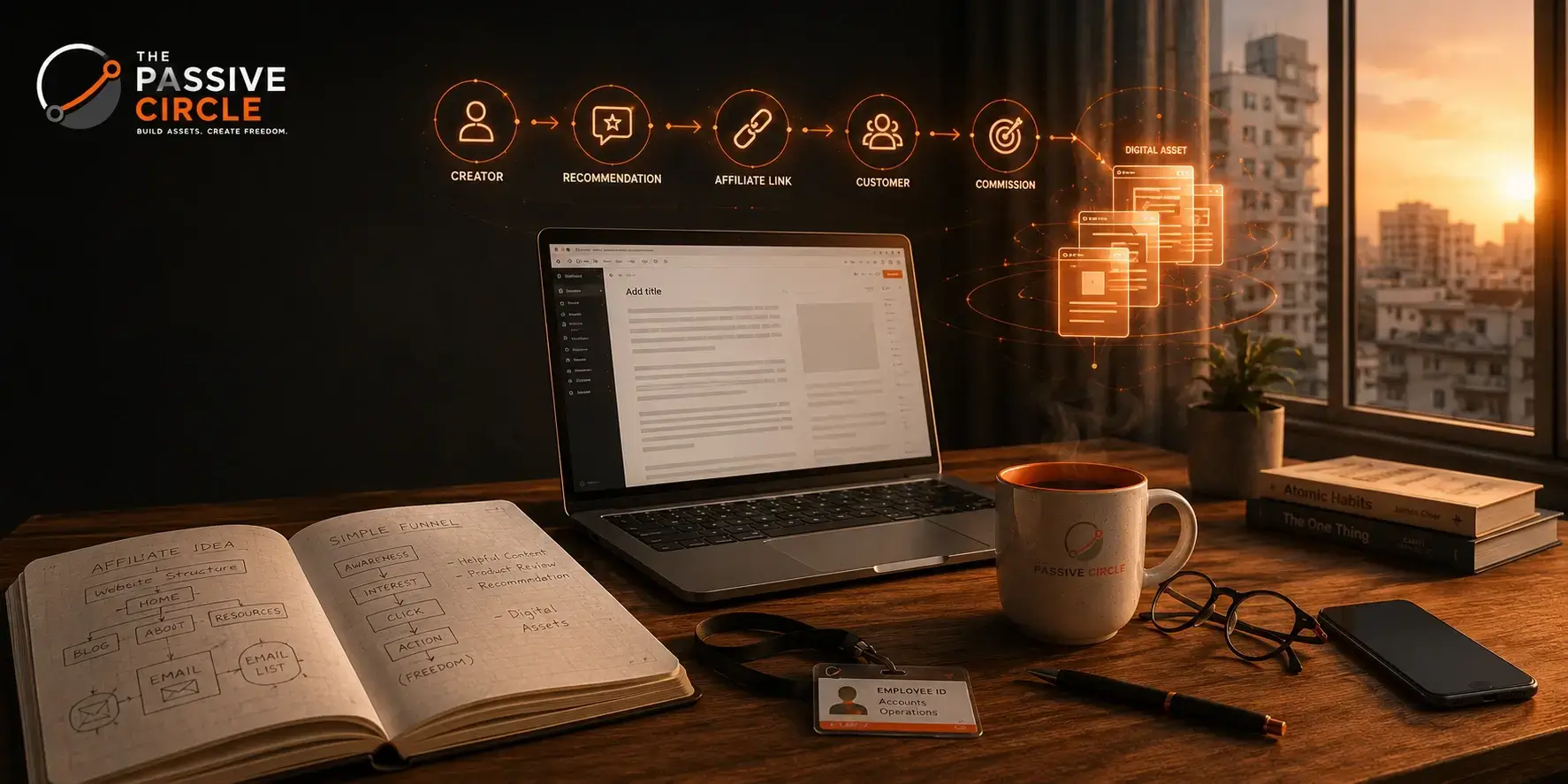
What Affiliate Marketing Actually Means
Affiliate marketing is a way of earning money by recommending someone else’s product or service.
You share a special link. If someone clicks that link and buys, you earn a commission. You never have to create the product, manage inventory, or handle customer support yourself.
You are not selling a product. You are recommending one, and getting paid when your recommendation leads to a sale.
How It Works, Step by Step
The process is simpler than most beginners expect. Here is the full path from your link to your payout.
The full affiliate loop, from your link to your payout.
The “cookie” in step three is not something scary. It is just a small tracking file your browser holds, like a name tag that says “this visitor came from Selim’s link.” It is what lets the merchant credit the sale to you, even if the reader buys three weeks later instead of that same day.
The Four Parties Involved
Every affiliate sale involves four roles, even when a reader only notices one or two of them.
The sale flows clockwise: merchant to customer to network to affiliate, and back again.
| Party | What They Do |
|---|---|
| Merchant | The company that owns the product or service being sold |
| Affiliate | The person recommending the product, using a tracked link (this is your role) |
| Network | The platform that tracks clicks and sales and handles payouts, when the merchant uses one |
| Customer | The person who clicks the link and makes the purchase |
Some merchants run their own affiliate program directly, without a network, the way Systeme.io tracks and pays affiliates in-house. Others rely on a third-party network like ShareASale or CJ Affiliate to handle tracking and payouts across hundreds of merchants at once.
How Commission Actually Gets Paid
Commission structures vary by program, but most fall into a few common types.
| Commission Type | How It Works |
|---|---|
| One-time percentage | You earn a set percentage of a single purchase, paid once |
| Recurring commission | You keep earning a percentage every month the customer stays subscribed |
| Flat rate | You earn a fixed dollar amount per sale or signup, regardless of price |
| Tiered commission | Your percentage increases as your total referred sales grow |
A tiered example makes this clearer. A program might pay 20 percent commission for your first 10 sales, then raise that to 30 percent once you pass 10 sales in a month. The more consistent value you send them, the more they share back with you.
Recurring commission is the type I pay the most attention to, since it can keep paying out from work I already did months ago.
Why Companies Use This Business Model
Affiliate marketing exists because it lowers risk for the company paying out.
Compare it to paid ads. A company running Facebook or Google ads pays upfront, whether or not anyone buys. With affiliate marketing, the company only pays after a sale actually happens.
There is no upfront advertising cost with no guaranteed return. This is why so many software companies, from hosting providers to SaaS tools, run affiliate programs instead of relying only on paid ads.
I have lived this example myself. I started my own site on ExonHost, mainly for the local support and the local payment option, which mattered a lot when I was just starting out. Once I had access to a global payment option and my site kept growing, that same local hosting started responding slower under the extra load. That is what pushed me to migrate to Hostinger instead. That single switch is a real example of how commission actually gets triggered: a hosting company only pays when a reader like you makes that same move.
Types of Affiliate Marketing
Not every affiliate marketer works the same way. Here are the most common approaches beginners run into.
- Content and review sites. Blog posts that compare or review tools in detail, like the ones on this site. If you want to build one of these yourself, start with setting up your WordPress website.
- Coupon and deal sites. Sites focused on discount codes and limited-time offers.
- Influencer and social media. Recommendations shared through Instagram, YouTube, or TikTok posts.
- Email marketing. Promoting products directly to an email list the affiliate has built. I cover exactly how in building your email list from day one.
- Comparison and “best of” sites. Pages that rank several options side by side for a specific need.
Advantages
- Low starting cost, often just hosting and a domain name. See the best beginner-friendly hosting options if you are choosing one.
- No product creation, shipping, or customer support required
- Content can keep earning long after it is published
- Works from anywhere with an internet connection
- Some programs offer recurring commission, not just one-time payouts
Limitations
- Income is not guaranteed and usually starts slowly
- You depend on the merchant’s program terms, which can change
- Search rankings take time to build, often several months. Picking the right keywords early makes a real difference, which is why I put together a free keyword research workflow for beginners.
- Some niches are far more competitive than others
- Trust has to be earned before readers click your links at all
Common Myths
| Myth | Reality |
|---|---|
| You need a huge following to start | Search-based content can earn without any social following at all |
| It is fully passive from day one | Early months take real, active work before it slows down |
| Any product will sell if you link it | Readers can tell when a recommendation is not genuine |
| It is a scheme, not a real business model | It is a standard, widely used marketing method for real companies |
Is It Legit?
Yes. Affiliate marketing is a standard part of how many legitimate companies acquire customers, and it is regulated in most countries through disclosure requirements.
In the United States, the Federal Trade Commission requires affiliates to clearly disclose when a link earns them a commission. Honest disclosure, not hidden persuasion, is what keeps this model trustworthy.
A legitimate affiliate program never charges you money to become an affiliate. If a “program” asks you to pay to join, that is the biggest warning sign of a scam, not real affiliate marketing.
Frequently Asked Questions
Is affiliate marketing free to start?
The business model itself is free to join. Most beginners still need a small budget for hosting and a domain name, usually a few dollars a month, before they can publish content.
How much money can a beginner realistically make?
It varies a lot by niche and effort, and most beginners earn little to nothing in the first few months. Income tends to grow slowly as content builds trust and search rankings improve.
Do I need a website to do affiliate marketing?
No, but it helps. Some affiliates work only through social media or email, but a website gives you a place you fully own, instead of depending entirely on a platform’s algorithm.
Is affiliate marketing the same as dropshipping?
No. In dropshipping, you still handle the sale, pricing, and customer service, even if a supplier ships the product. In affiliate marketing, the merchant handles the entire sale. You only make the introduction.
Is affiliate marketing a type of MLM?
No. MLM structures pay you for recruiting other sellers into a downline. Affiliate marketing pays you only for sales or leads you personally generate, with no recruitment layer involved.
How long does it take to see affiliate income?
Most beginners see their first real income somewhere between three and six months of consistent publishing, though this depends heavily on the niche and competition.
Where to Go From Here
If you want to understand why I chose this model over freelancing and a regular job, that full story is in why I chose affiliate marketing to build digital assets.
If you want the full beginner walkthrough, from picking a niche to your first sale, I cover it step by step in my affiliate marketing guide for beginners.