When I first started this blog, finding keywords felt impossible. Every time I searched something in Google, I saw Forbes, HubSpot, and Backlinko dominating page one. I felt stuck before I even started writing.
Then I discovered LowFruits. It changed how I approach keyword research completely.
In this LowFruits review, I will show you exactly how I use the tool to find low-competition keywords, analyze Google search results for weak sites, and build a content plan that a beginner blog can realistically rank with.
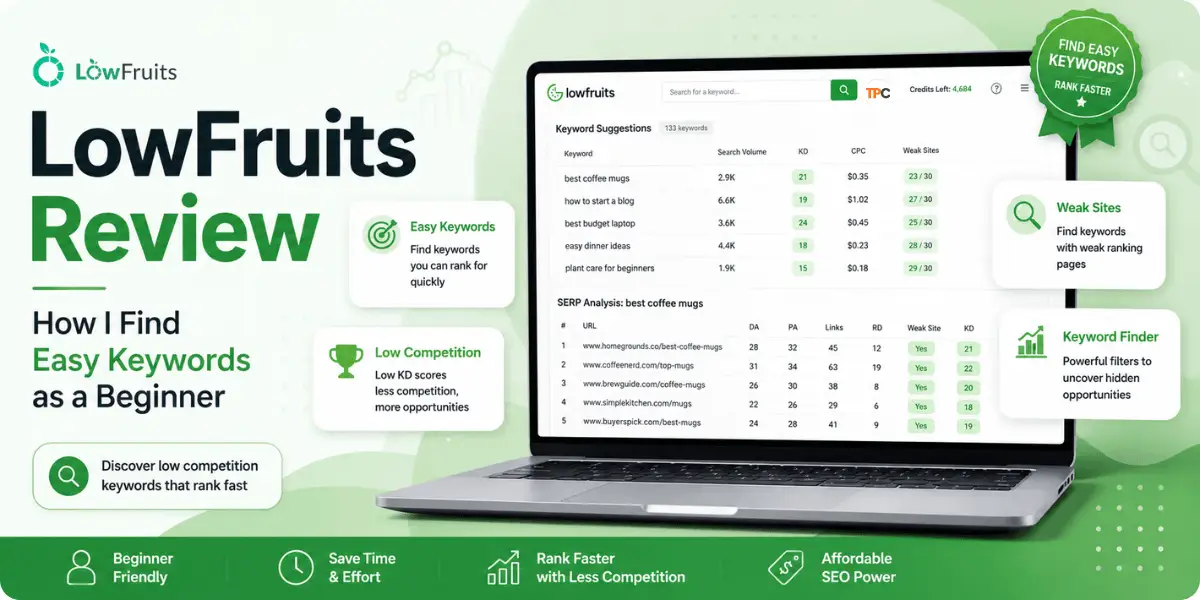

LowFruits is the best keyword research tool for beginner bloggers who want to rank without a big budget or a site with years of authority behind it.
What Is LowFruits? (And Why Beginners Love It)
LowFruits is a keyword research tool built to help you find low-competition keywords that a new or small blog can realistically rank for. It works by scanning Google’s actual search results and flagging keywords where weak, low-authority websites are already on page one. That is your signal. If a small site is up there, you have a real shot too.
The name says it all. Instead of fighting for terms that only authority sites can win, you focus on the gaps, the easy keywords where the competition is genuinely thin.
One thing worth knowing: LowFruits was acquired by AIOSEO (part of Awesome Motive, the company behind WPForms and MonsterInsights) back in May 2024. It still operates independently with the same features. If anything, it now has more resources to grow.
How the SERP Weakness Score Works
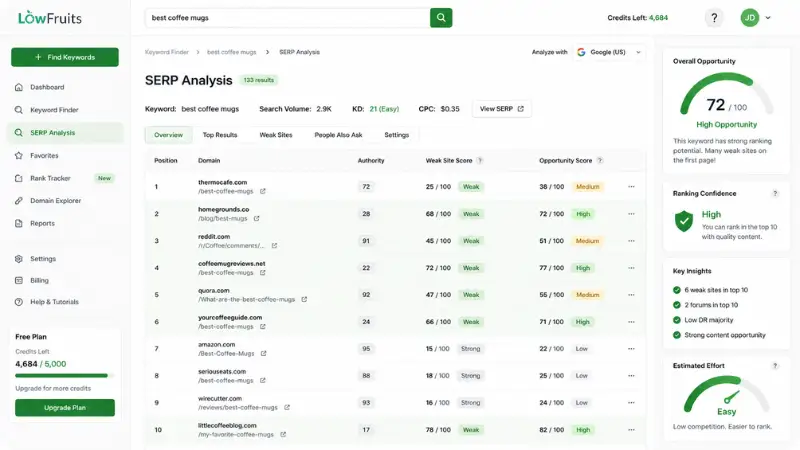
This is what makes LowFruits different from every other keyword tool. When you enter a keyword, it scans the top Google results and counts how many weak domains are ranking. It turns that into a simple color-coded weakness score.
A low score means more weak sites are present on page one. That is exactly what you want to see. You are not guessing at keyword difficulty. You are looking at real evidence that small sites can compete for that term.
This kind of SERP analysis is especially powerful for niche keyword research, because it reveals opportunities that standard keyword difficulty scores often miss entirely.
Who Is Behind It and Can You Trust It?
LowFruits was built by a solo developer named Paul, who ran it for three years before selling to AIOSEO. With Awesome Motive behind it now, a company trusted by over 3 million WordPress users, there is real accountability and staying power behind the product.
LowFruits Pricing: Plans, Credits, and What Actually Makes Sense
This is where LowFruits really stands out from the competition. You do not need to commit to a monthly subscription just to get started. There are two ways to pay: a subscription that gives you recurring monthly credits, or a pay-as-you-go option where you buy credits only when you need them.
Subscription Plans (Best Long-Term Value)
Pay-As-You-Go Credits (Great for Occasional Research)
PAYG credits stay valid for one full year. If you only do keyword research once or twice a month, this option can save you money over a subscription.
All paid plans come with a 14-day money-back guarantee. Check the current LowFruits pricing →
LowFruits Review: Key Features I Actually Use Every Week
I have been using LowFruits for several months. Here are the features that made the biggest practical difference for me as a beginner blogger trying to get traffic on a tight budget.
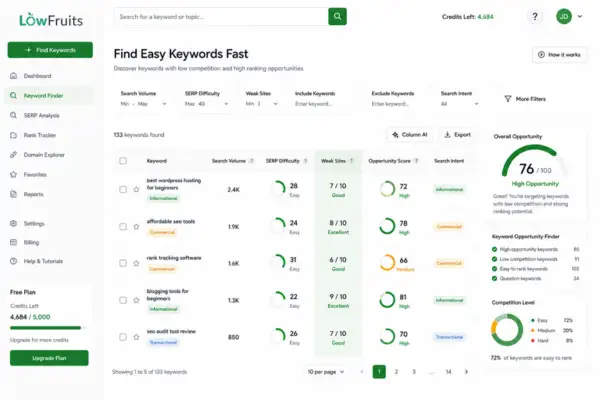
Keyword Finder with SERP Weakness Analysis
This is the core of the tool. You type in a seed keyword, and LowFruits pulls long-tail suggestions directly from Google Autocomplete. Then it scans the top search results and assigns a weakness score to each one.
The score tells you how many low-authority domains are already ranking for that keyword. Green means opportunity. The more green you see, the more realistic your chances are as a small site. I have found dozens of keywords this way that I would never have discovered on my own.
Bulk SERP Analysis (Import Your Own Keywords)
One feature I rely on every week is the bulk import. I take keywords from Google Search Console, Ubersuggest, or even ChatGPT, paste them into LowFruits, and let it run SERP analysis on all of them at once. Instead of checking results manually one by one, I get a complete weakness report in a few minutes.
This alone saves me hours. I used to spend entire evenings opening individual search result pages and guessing whether I could rank. Now I glance at the weakness column and know immediately which ones are worth writing about.
If you want to understand the basics before diving in, Google’s official SEO starter guide is a solid grounding in how search rankings work and why targeting the right keyword matters so much.
Domain Explorer
The Domain Explorer gives you access to a database of over 150,000 weak websites. You can filter by domain age, number of indexed pages, and authority level. It helps you spot patterns in the types of sites that keep appearing in easy SERPs, so you can find entire keyword clusters worth going after.
Keyword Rank Tracker
The Standard plan includes tracking for 100 keywords. You add your target terms, and LowFruits shows you where your pages are ranking over time. Having rank tracking built directly into the same tool you use for research is genuinely useful when you are managing costs carefully.
My Real Results Using LowFruits
I want to be honest with you here. LowFruits is not magic. You still need to write content that actually helps people. But what the tool does is remove the guesswork about which keywords are worth your time in the first place.
Before LowFruits, I was writing posts based on what sounded interesting to me. Most of them sat on page three or four with almost zero traffic. It was demoralizing. I could not figure out what I was doing wrong.
After running my keyword ideas through LowFruits and filtering specifically for weakness scores that showed real gaps, things started to change within a few weeks. Posts I wrote around those weaker keywords started showing up on page one for their target phrases. Nothing dramatic at first. But real, organic traffic from real readers, not bots, not social media bursts, but people finding me through Google.
The biggest lesson I took away: the right keyword matters more than article length. A 600-word post targeting a genuinely weak keyword will almost always outperform a 3,000-word post fighting for a term dominated by authority sites.
If you are new to SEO keyword research, I would also recommend reading my guide on how to do keyword research for free before diving into paid tools. It gives you the right mindset for how to use a tool like LowFruits effectively.
LowFruits vs Ahrefs: Which Should Beginners Actually Use?
Ahrefs is one of the most powerful SEO platforms in the world. It is also $129 per month for its cheapest plan. For most beginners just starting out, that is simply not a realistic starting budget.
LowFruits solves a specific problem that Ahrefs does not focus on: finding keywords where weak sites are already ranking on page one. Ahrefs gives you keyword difficulty scores, but those numbers do not tell you whether a new blog can realistically compete. LowFruits shows you the actual composition of the search result page, so you can make a smarter, more informed decision.
| Feature | LowFruits | Ahrefs |
|---|---|---|
| Starting price | $21/month | $129/month |
| SERP weakness analysis | Core feature | Not available |
| Pay-as-you-go option | Yes, from $25 | No |
| Backlink analysis | Not included | Very detailed |
| Best for | Beginner bloggers | Established SEO teams |
| Money-back guarantee | 14 days | No refunds |
My honest take: if you are running a new blog on a tight budget, LowFruits is the smarter first tool. Save Ahrefs for when you already have consistent traffic and revenue coming in. For complementary free tools in the meantime, check out my post on how to use Ubersuggest for SEO , it pairs really well with LowFruits in a beginner tool stack.
LowFruits Review: Pros and Cons
Ready to Find Keywords You Can Actually Rank For?
LowFruits is the tool I wish I had found when I first started blogging. Start with the $25 PAYG pack and see what low-competition keywords are hiding in your niche. No subscription required.
Start with LowFruits Today →Frequently Asked Questions
After several months of testing, this LowFruits review comes down to one clear conclusion: it is the most practical keyword research tool for beginner bloggers who want to find low competition keywords and actually build real search traffic from scratch.
LowFruits will not do the writing for you. But it takes the guesswork out of what to write about, and that is the most valuable thing a new blogger can have.