Anthropic just started adding an invisible watermark to text created by its newer Claude models. If you use Claude anywhere in your blogging workflow, you have probably seen the headlines and wondered the same thing every content creator is asking right now: can people tell when I used AI to write something?
The short answer is not a clean yes or no. The watermark is real. Anthropic confirmed it in August 2026. But it does not work the way most people assume, and it cannot prove that Claude wrote an entire article from start to finish.
Yes, supported Claude models now embed an invisible, machine-detectable watermark into generated text. It does not identify the person who used Claude, and it does not prove Claude wrote an entire article on its own, since light edits can leave too little signal to detect. There is currently no public Google guidance saying a detected watermark itself lowers rankings. Google’s stated focus stays on whether content is accurate, original, and genuinely useful.
- Claude models launched on or after August 2, 2026 embed the watermark at launch, with older models being added over time
- The watermark does not change the meaning, quality, or readability of Claude’s responses
- It travels through copy and paste and may survive light editing, but not heavy rewriting
- It does not identify the specific person, account, or organization that used Claude
- A public detection tool is planned but not yet available
- There is no reason to panic or stop using Claude because of this
- Editing a draft to try to hide AI involvement is not a useful strategy
- Original testing, examples, and editorial judgment still matter more than ever
- Fact-checking and the final publishing decision should stay in your hands
What Happened With Claude’s New Text Watermark
In August 2026, Anthropic confirmed that supported Claude models now embed a machine-readable watermark directly into the text they generate. Models launched on or after August 2, 2026 support the marking from day one, and Anthropic says it is working to add the same capability to older models over time.
You will not see anything different when you copy a Claude response into WordPress. No visible label, no strange symbol, no extra formatting. The mark is designed to be invisible to a normal reader while still being detectable by machines that know how to look for it.
The trigger for this change is the EU AI Act, specifically Article 50, which requires providers of generative AI systems to make certain AI-generated content identifiable in a machine-readable format. Anthropic signed the EU’s Code of Practice on Transparency of AI-Generated Content alongside most other major AI labs, and rather than limit the watermark to European users, applied it globally across the Claude Platform API, claude.ai, Claude Code, Claude Cowork, and Claude Tag.
What Is a Text Watermark, and Is It Hidden Characters?
A lot of the early confusion online came from people assuming Claude inserts something like a zero-width space or a hidden Unicode character somewhere in the text. That is not how this works.
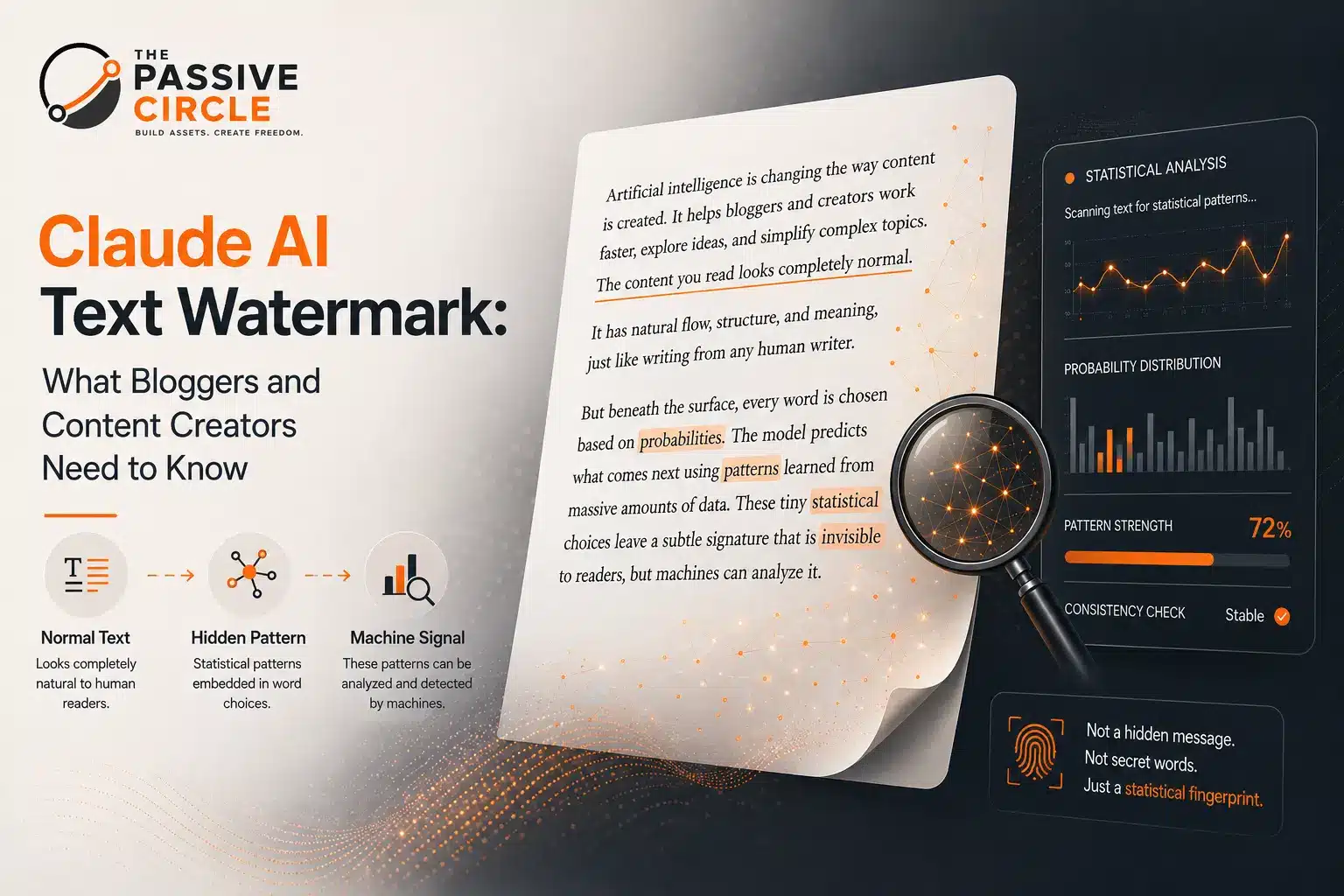
Anthropic’s approach is closer to a statistical fingerprint than a hidden message. It is based on SynthID-Text, an approach originally developed by Google DeepMind. Instead of inserting extra characters after the fact, the watermark is created while the text is being generated, by subtly influencing certain word choices as Claude writes.
Your readers see a normal sentence. Nothing looks unusual, and the meaning, quality, and readability of the response are unaffected. But underneath that normal-looking sentence, a pattern exists in some of the word choices, and a system with the right key can check for that pattern later.
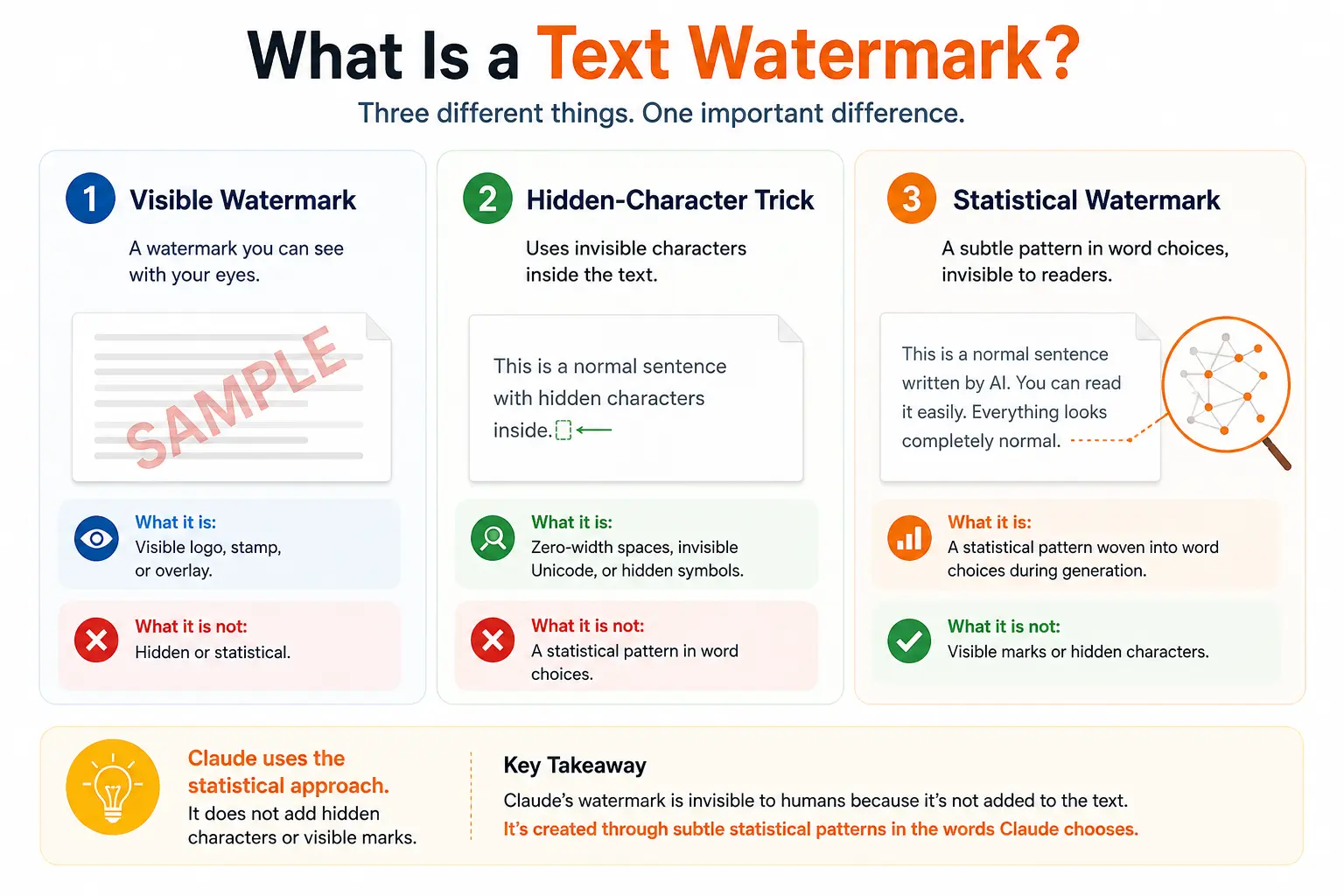
This distinction matters practically. If you paste Claude’s output into a WordPress Custom HTML block, you will not find a secret string of characters hiding in the text. A basic hidden-character checker cannot detect Claude’s watermark, because there is no hidden character to find.
How Claude’s Watermark Actually Works
When Claude generates a sentence, there are usually several reasonable next words to choose from. A sentence like “the weather today was cold and…” could reasonably continue with “grey” or “overcast.” The model already assigns different probabilities to each option before picking one.
Anthropic’s watermarking system uses exactly these kinds of low-stakes choices to build a pattern. One word choice on its own tells you nothing. But across a full paragraph or article, thousands of these small choices form a pattern that a detector with the correct key can recognize.
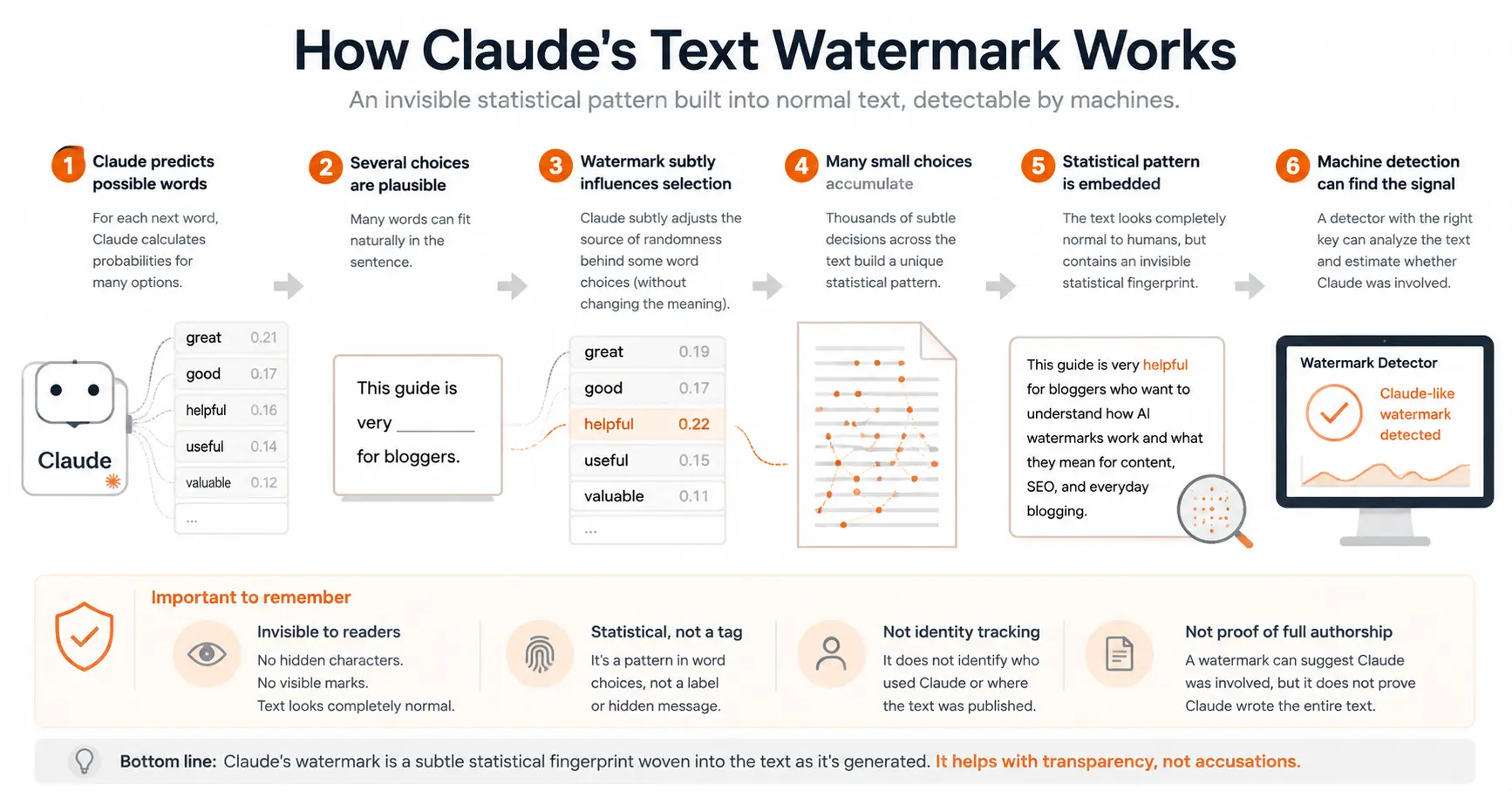
This also explains one important limit. The watermark needs enough generated text to build a reliable signal. A single headline or a one-sentence answer may not contain enough word choices to detect anything meaningful. Code is affected even less, since correct code usually has only one right answer, leaving little room for the kind of flexible word choice the watermark relies on.
Watermark Detector vs. AI Detector vs. Plagiarism Checker
These three tools get confused constantly, and the confusion matters because a blogger might see a scary-looking score from the wrong tool and draw the wrong conclusion.
| Technology | What it checks | What it does NOT prove |
|---|---|---|
| Watermark detector | Looks for Anthropic’s specific statistical signal using a private key | Who used Claude, or that Claude wrote the whole piece |
| AI detector | Estimates whether writing style resembles AI-generated text | Actual AI involvement. Style-based scores carry real error rates |
| Plagiarism checker | Compares your text against existing published content | Whether AI was involved at all |
A website claiming a piece of writing is “95% AI-generated” has not detected Claude’s watermark. It is running a style-pattern analysis, a different method with its own error rate. Anthropic has said it plans to release a dedicated watermark detection API, but that tool is not yet publicly available.
Does a Detected Watermark Prove Claude Wrote the Article?
No, and this is the most important distinction in the entire topic. A detected watermark can indicate that Claude was likely involved in producing or processing the text. It does not establish that Claude wrote the whole piece, and it does not identify who used Claude to write it.
The amount of Claude involvement matters too. If you write an article yourself and ask Claude only to fix a few grammar mistakes, there may not be enough watermarked text for reliable detection. If you ask Claude to draft several paragraphs or the full article, there are far more opportunities for the pattern to form.
Watermark detected means Claude was likely involved.
It does not prove Claude wrote the entire article.
It does not identify the person who used Claude.
Can Editing, Paraphrasing, or Translation Remove It?
The watermark is not permanent. Anthropic says it can survive some editing, but it is not built to withstand every kind of change. Light edits likely leave much of the underlying pattern intact. Heavier changes, like rearranging a full article or blending AI output with a lot of original writing, reduce how much of the original signal remains.
Editing is not a tool for hiding AI involvement, and it should not be treated as one. The real reason to edit AI-assisted drafts is to make them more accurate, more specific, and genuinely useful to your reader.
Does This Affect Google SEO?
- Helpful, people-first content
- Original information and firsthand insight
- Accuracy
- Real value for the reader
- Avoiding scaled content abuse (mass low-value automation)
Google’s published guidelines focus on the quality, accuracy, originality, and usefulness of content, not on whether AI was involved in producing it. Google has said directly that using AI to help create content is not automatically against its guidelines. The actual concern Google has described is scaled content abuse, meaning automation used to mass-produce large volumes of low-value content mainly to manipulate rankings.
We do not think a hidden watermark changes how we use AI tools at The Passive Circle. The tools and workflows we write about here work the same way they did before this announcement. What has always mattered for ranking and reader trust is whether an article adds something real, not whether a machine can detect which words came from a human first.
For a blog like this one, that reframes the real question. It is not how do I hide that I used AI. It is what value does this article add that a generic AI summary would not.
Why Is Anthropic Doing This?
This is not primarily a system built to catch individual bloggers using AI. It is part of a broader push toward AI transparency and content provenance, driven directly by regulation. The EU AI Act’s transparency requirements became enforceable on August 2, 2026, and Anthropic signed the EU’s Code of Practice on Transparency of AI-Generated Content alongside most other major AI labs, including Google, Meta, Microsoft, and OpenAI.
Rather than limit compliance to European traffic, Anthropic chose to apply the watermark worldwide. For files like PNG, JPG, and SVG images, Anthropic takes a different approach, attaching signed provenance metadata using the C2PA standard instead of an embedded watermark.
What Should Bloggers Actually Do?
Nothing about this watermark is a reason to stop using Claude for blogging. Claude remains genuinely useful for research, outlining, organizing ideas, editing, and improving clarity. What matters is what you personally add on top of that: verified facts, real examples, your own testing, and the editorial judgment to decide what is actually worth publishing. If you’re already using free AI tools in your workflow, this is the same principle applied one level deeper.
- Brainstorming
- Research support
- Outlining
- Organizing ideas
- Editing
- Improving clarity
- Fact-checking
- Firsthand experience
- Testing
- Opinions
- Editorial judgment
- Final publishing decisions
One more habit worth keeping: your own first draft, tested claims, and the process of writing your first post yourself already teaches most of this. AI speeds up the parts of the process that benefit from speed. It should not replace the parts that depend on your judgment.
Frequently Asked Questions
No. Anthropic says the watermark contains nothing that can identify a specific user, account, organization, or conversation.
No. Anthropic says watermarking has a negligible effect on speed and does not require additional tokens or increase cost.
Not really. Code usually has one correct answer, leaving little room for the flexible word choices the watermark relies on. Comments and documentation can still carry some signal.
Yes. Since Claude generates every word of a translation, the translated text carries the same watermark as original generation would.
Not yet, at least not reliably. Anthropic has said a detection API is in development but has not made a full public detection tool available as of this writing.
There is no universal rule requiring disclosure on every AI-assisted post. Google has said disclosure can be useful when readers would reasonably wonder how content was produced, but the more consistent requirement is that the content itself stays accurate, original, and genuinely useful.
Last verified: August 2026
Primary sources: Anthropic’s Help Center documentation on how Claude marks AI-generated content, Anthropic’s engineering explainer on how the watermarking works, and the EU AI Act’s Article 50 transparency requirements.
Article focus: what Claude’s text watermark is, how it works, what it can and cannot prove, and what it means for bloggers publishing AI-assisted content. It does not cover Anthropic’s internal detection algorithm in technical depth.
Final Verdict: Should Bloggers Worry About Claude’s Watermark?
Not really, and definitely not enough to change how you use Claude. The watermark is real, and it is designed to be detectable by machines. But it does not trace content back to a specific person, and it does not prove Claude wrote an entire article on its own.
For SEO specifically, nothing here changes the rule that has mattered all along. Google cares about whether the content is accurate, original, and genuinely useful to the person reading it, not whether AI touched it.